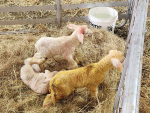
Beef + Lamb NZ's Lambing Kit Checklist for a Tough Season
With lambing underway in many regions, Beef + Lamb New Zealand is encouraging farmers to put together a wellequipped lambing kit to help minimise lamb losses, particularly in bad weather.
 increase font size
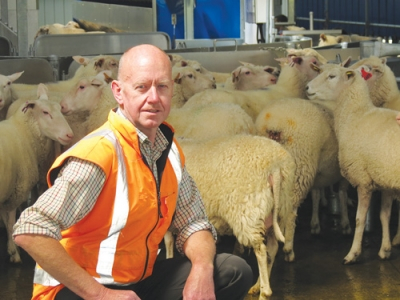 John Ryrie, sheep dairy manager at Spring Sheep Milk.
Milking sheep is much easier and simpler than cows, but it takes much more dedication and attention, says John Ryrie, sheep dairy manager at Spring Sheep Milk.
“You need good stockmanship to look after sheep,” he told Rural News.
A Scotsman, Ryrie has been in New Zealand for the past year as farm manager for Spring Sheep but has been sheep milking in the UK for 20 years.
“They are less forgiving than cows,” he says. “If you get the nutrition wrong for a few days then they won’t forgive you and give you the milk back. Once you get that nutrition wrong you lose that milk regardless of what you do afterwards, whereas cows are more forgiving.”
Sheep have a better memory than people realise, he says.
“Once they’ve got a system they will follow that system or that route back and forth to paddock without dogs. They will go themselves, they will come in themselves. They will come into the parlour themselves, they will go through the parlour and exit themselves.”
Ryrie says sheep are not as silly as people make out and have a very good long term memory.
“So if we come out of season and we dry them off and start up a new season, they will follow the routine we gave them the year before. Once we get them trained initially, it is easier and simpler for them to follow what we need to do.”
Ryrie thinks the potential for sheep milk is huge.
“I’ve travelled in Europe and I have travelled in Canada in the past and in the market the demand for sheep milk, as far as I can tell, exceeds supply by quite a factor worldwide.
“The main factor is to get the link between the consumer and production right, and I think NZ has that under control.
“In a lot of other countries they don’t have that link set up between demand and production.”
He says onfarm production needs to increase in NZ to make sheep milking viable and this comes down to genetics and nutrition: “they go hand in hand”.
“You can have good genetics, but if you don’t have good nutrition you won’t make the same gains.”
With lambing underway in many regions, Beef + Lamb New Zealand is encouraging farmers to put together a wellequipped lambing kit to help minimise lamb losses, particularly in bad weather.
Will a stronger, more coordinated voice help rebuild confidence and improve returns in the wool sector?
Sheep infant nutrition maker Blue River Dairy is hoping to use its success in China as a springboard into other markets in future.
Sheep milk processor Maui Milk is on track to record average ewe production of 500 litres by 2030, says outgoing chief executive Greg Hamill.
The vineyards at Pyramid Farm in Marlborough’s Avon Valley have never been run of the mill, with plantings that follow the natural contours of the land, 250 metres above sea level.

Farms across the upper North Island are trialling different pasture mixes as part of a research programme that aims to build greater resilience into farming systems.
Election years are always a concerning time for farmers, according to DairyNZ chair Tracy Brown.
The Ballance Farm Environment Awards are coming to the West Coast of the South Island.
Most dairy regions around the country have had a pretty good season so far says Tracy Brown.
Rural leader Mark Hooper has been appointed as an independent director to the NZPork board, bringing extensive farming, governance and advocacy experience to the role.