A simple DIY test for farmers is a cost-effective way to manage nitrogen levels in soil, a three-year project has shown.
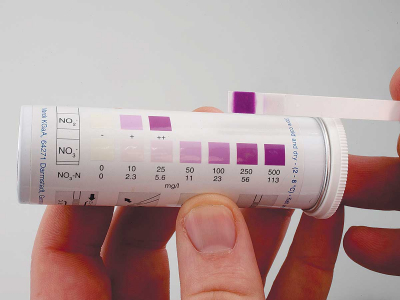
The Foundation for Arable Research (FAR), backed by the Ministry for Primary Industry’s (MPI’s) Sustainable Farming Fund and other collaborators, has tested the use of Quick Test nitrogen strips, originally used in the US by the vegetable industry.
Diana Mathers, FAR’s research manager in farm systems, says the research confirms the strips provide a useful gauge of nitrogen levels in New Zealand soils and farming systems.
In 14 of 18 trials, farmers were able to reduce the amount of fertiliser they applied – by up to 50% - without a loss in yield, said Mathers.
The test could be used at any stage of a crop rotation, to help inform the decision about how much nitrogen to put on, she said.
“It can either confirm that he’s on track with the yield he’s expecting, or maybe there’s enough nitrogen in the soil and he can cut back. Or the other side of that, maybe he can add a bit more.
“To manage nitrogen without great losses to the environment, farmers need to know how much nitrogen is in the soil. The way to do this in the past was by mineral N tests in a laboratory which are quite expensive and we found that some farmers weren’t doing them.
“We hope that this much cheaper solution will encourage more soil testing.”
A $200 kitset now available from Lab Supply, Dunedin, includes tubes, a rack, calcium chloride (used as the reagent to extract nitrogen from soil samples) and 100 strips – meaning each test costs just $2 versus $50 in a laboratory.
Mathers said the testing process could take as little as 1.5 hrs including collecting soil by corer or auger, and sieving and mixing to make a homogenous sample.
A small amount is shaken up in a calcium chloride solution and allowed to settle. A test strip is then dipped in and a colour change on the strip shows the current nitrate level in the soil.
The farmer then consults the Quick Test Tool, a chart on an Excel spreadsheet that helps determine how much, if any, nitrate is needed for their particular crop.
“The nitrogen strips are an economical way to test every paddock at the start of the season.
“While costs may seem daunting at first the savings on fertiliser costs far outweigh this,” said Mathers.
“What would work well for farmers is if they get together with, say, a group of three and set themselves up with a kitset, then they could work together and support each other and learn from each other.”
Steve Penno, director investment programmes at MPI, says the results of the research inspire confidence for farmers.
“Responsible nutrient management is essential to protect the health of our waterways. MPI is delighted to support this research, which shows that these nitrogen strips are effective in New Zealand soils. This is a practical and cost effective tool for farmers that will help them with nutrient management.”
The next step would be to develop an online version of the tool and add more crop types, including forage crops.
Mathers said the test was potentially transferable across all farming systems.
The project was done on maize, potatoes and leafy green vegetables but is now widening out into wheat, seed, forage for dairy support and other vegetables.