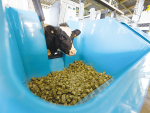
Climate-friendly cows closer
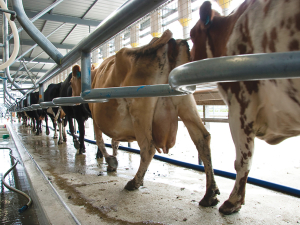
Dairy farmers are one step closer to breeding cow with lower methane emissions, offering an innovative way to reduce the nation's agricultural carbon footprint without compromising farm productivity.
 increase font size
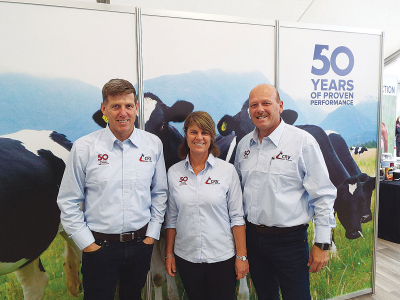 Visiting CRV Global chief executive Roald van Noortfrom (right) with CRV Ambreed managing director Angus Haslett and marketing manager Katrina Evans at the Fieldays.
Five gold coloured semen straws each representing a $2000 cash prize will entice farmers during the artificial breeding season.
CRV Ambreed in August and September will slip the straws into its stocks of AB products, says marketing manager Katrina Evans.
This Golden Straw promotion is part of the company’s 50th anniversary of business in New Zealand.
The company lays claims to several first during its 50 years here: cross-bred genetics in the 1990s, facial eczema tolerant sires with AgResearch in 2014 and in 2017, and LowN Sires to enable a reduction of nitrate leaching caused by the concentration of N in cattle urine.
It launched sexed semen in NZ 10 years ago and has since followed the technology, said to help improve animal welfare.
At the recent National Fieldays, the chief executive of CRV Global, Roald van Noortfrom, visiting from the Netherlands, gave Dairy News insights into where the company is heading.
On the 2018 acquisition of the start-up semen sorting company Engender, at Auckland University, van Noort said “it’s great to invest in NZ, with a company that has a NZ presence, and in doing so commit to develop even better technologies in the field of semen sorting”.
He said that data will play a crucial part in R&D, looking at feed intake in real time, the measurement of nutrient content of excreta and understanding more about methane production. Data analysis will lead to choosing sires with desirable genomes, good for sustainability and the environment.
CRV Ambreed managing director Angus Haslett said the company spends at least 20% of revenue on R&D to keep up in genetic technology. This will contribute to the LowN programme underway with DairyNZ, AgResearch and Fonterra, and may lead to the creation of industry breeding values for nitrogen excretion.
Said Haslett, “CRV has for years invested in helping farmers create herds that are productive and environmentally sustainable, for example its health and efficiency indexes”.
“CRV is confident some of the extended global research will directly benefit the NZ dairy industry.”
Roald van Noort visits the southern hemisphere two-three times annually. He said internationally the dairy industry’s consumers of its “white gold” are much more aware of environmental problems caused by modern farming.
The resulting drive to sustainability will require a lot of spending.
“Farmers in the Netherlands are rewarded for sustainable practices that have minimal impact on the environment. Farmers who focus on such matters receive increased payouts via their milk company who in return gain higher prices from their retailers.
“These retailers can sell at an increased price to consumers who are happy to pay a premium for such actions knowing they in turn are helping the environment.”
It’s encouraging to see signs of this developing in NZ and CRV wants a part in this, Haslett said.
Dairy farmers are one step closer to breeding cow with lower methane emissions, offering an innovative way to reduce the nation's agricultural carbon footprint without compromising farm productivity.
CRV has produced the first homozygous polled bull to make New Zealand’s prestigious Ranking of Active Sires (RAS) list, demonstrating the strides the company is making in breeding top-quality polled bulls.
As Mycoplasma bovis (M. bovis) resurfaces in Canterbury, CRV is reassuring dairy farmers it has rigorous production processes and health testing programmes in place within its supply chain.
A Canterbury Hereford stud specialising in providing beef genetics for the dairy industry is claiming a major breakthrough in breeding for more environmentally friendly animals, with reduced urinary nitrogen emissions.
Some dairy farmers could be missing out on up to 160 kgMS of production because they are not herd testing.
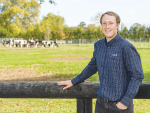
DairyNZ deputy chair Cameron Henderson has been re-appointed unopposed for another term.
Farms across the upper North Island are trialling different pasture mixes as part of a research programme that aims to build greater resilience into farming systems.
Election years are always a concerning time for farmers, according to DairyNZ chair Tracy Brown.
The Ballance Farm Environment Awards are coming to the West Coast of the South Island.
Most dairy regions around the country have had a pretty good season so far says Tracy Brown.