Editorial: Common Sense Prevails
OPINION: The Government's decision to reinstate agriculture and horticultural science as a standalone subject from Year 11 is the right one.
 increase font size
 Chris Lewis.
Federated Farmers says tens of millions of dollars worth of farm production and the jobs of other workers are at risk if the Government continues to dither on allowing a limited number of skilled agricultural machinery operators into New Zealand.
Federated Farmers spokesperson on employment, Chris Lewis, says it has almost gone past critical now because the country is on the cusp of spring activity and there is a need to get these seasonal workers on flights and into quarantine for two weeks.
He says it’s interesting that exemptions have been allowed for workers laying synthetic tracks for horse racing, for the movie industry, and others.
“The fact is that the primary industries can help us pave the way to post-Covid economic recovery, but not if crucial cogs in our production systems are hobbled by key gaps in the workforce.”
Rural Contractors NZ has just finished surveying its members and has found that 57 contractors urgently need a total of 206 skilled operators, to service 8213 clients.
Many of those clients will be Federated Farmers’ members, he says.
It is estimated that if the highly skilled drivers and operators are not brought in from overseas, there could be a loss of nearly 28 million tonnes of production with a value in excess of $110 million.
Lewis says the federation shares the Government’s desire to train Kiwis for these roles, and action is happening on that front with the 40 places on the first of six planned agricultural driver courses at SIT’s Telford campus already taken. He says these people should graduate with the ability to safely drive a tractor, but not the combine harvesters and silage machines that can be worth a million dollars or more.
“You don’t train someone to use a chainsaw, then send them out to bring down tall trees the next week. Newer drivers need to gain experience with tractors on basic tasks in simple country before they can move on to more complex machines.
“The majority of fatalities in agriculture involve vehicles and the last thing anyone wants is inexperienced vehicle operators put in situations where they end up having an accident.
“These skilled operators have been coming into New Zealand without problems in the past. But the pandemic restrictions have caught everyone on the hop,” he says.
Lewis says these are extraordinary circumstances and government sign-off of managed entry of these highly skilled operators, with the quarantine paid for by contracting firms, is crucial.
OPINION: The Government's decision to reinstate agriculture and horticultural science as a standalone subject from Year 11 is the right one.
With less than a week to go before voters choose the next government, Federated Farmers has a simple message to its members - get out and vote.
Federated Farmers has welcomed new rural policies released by ACT, saying they align closely with its own election priorities.
A farmgate milk price of $10/kgMS this season is firming up as milk powder prices soar and the New Zealand dollar weakens.
Federated Farmers is backing Feilding High School’s call to keep Agriculture and Horticultural Science as a standalone subject in Year 11.



Three men have been sentenced in District Courts after Ministry for Primary Industries prosecutions over animal welfare, food safety and cattle tracing offences.
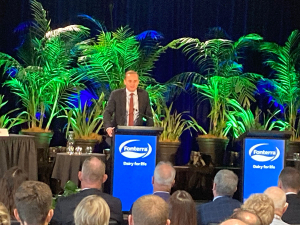
Fonterra’s 2026 financial year was a year of delivery, with record volumes of milk collected, processed and shipped by the co-op.
OPINION: The Government's decision to reinstate agriculture and horticultural science as a standalone subject from Year 11 is the right one.
Dairy farmers, still holding onto their Fonterra shares despite switching milk supply elsewhere or exiting the industry, now face a stricter share sell-down requirement.
Hamilton-based agritech company Aimer Farming has completed a $3 million capital raise to support its next stage of growth, including a beef farming product due to launch in 2027.
When dairy manager Miriam Lauridsen learned the farm, she was joining held weekly health and safety meetings, she initially thought that was “a bit over the top”. Experiencing that culture changed her mind.