While baler-wrapper combinations have become the backbone of baled silage production, one machine stands out from the rest in the layout of the machine.
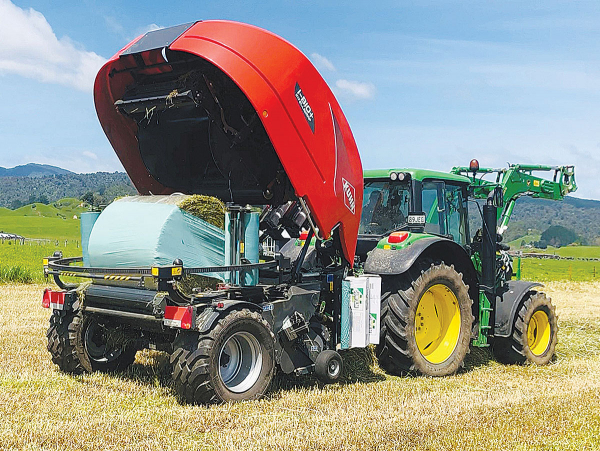
The Kuhn i-Bio+ takes the form of what appears to be a standalone baler, but once the bale is formed, it metamorphoses, by lifting the top half of the “bale chamber”, allowing a wrapping system to secure the package.
Originally from the Kverneland baler portfolio that was acquired by Kuhn, the Bio is now celebrating 20 years in production since its release in 2002. With compact dimensions of only 4.5m long, 2.75m wide and 2.25m high, with a tare weight of 3,700kg, the has found success with those farming in areas with small paddock sizes, wet or hilly areas and limited access.
The compact combination features a 2.3m wide pendulum pick-up unit with five tine bars and cam-track technology to maximise crop pick-up and transfer to the integral rotor system.
Options include the Opticut chopping system with a choice of 14 or 23 knife layouts, with the former offering a theoretical chop length of 70mm and the latter 45cm. Individual knives are protected with spring release mechanisms, while blockages are taken care of by the rotor disengage system and a drop floor design that clears problems quickly.
The bale chamber features 18 rollers that deliver bales of 122cm wide by 125cm diameter. Once a bale is formed, the upper portion of the machine tilts upwards, leaving the bale sitting on the bottom six rollers that act as a wrapping table.
Removing the need for any type of bale transfer as required by conventional combinations, twin 70mm wrapping satellites move around the wrapping track at around 50rpm, to deposit six layers of film on the bale in around 20 seconds. After wrapping, a low discharge height allows the wrapped bale to be placed back on the ground with no damage.
The i-BIO+ is fully ISOBUS compatible through the tractor terminal or, operated via a separate CCI 800 control unit. The machine can be used with conventional net binding or filmon- film bale binding and wrapping to eliminate the need for separate netting. Switching between film and net binding is said to be quick and simple as the two systems are separate.