Every farmer has had that cow that looked fine for the morning milk but was off by the arvo. By the time something was visibly wrong, the problem had been building for days.
That gap between what’s happening inside the animal and what you can see from the race is where wearable monitoring tech earns its keep.
Two signals, not one
CowManager combines continuous behaviour monitoring with real-time ear temperature tracking from a small earmounted sensor. Because it sits in the ear, it captures small, precise micro-movements in how the cow is moving both her ear and how she’s holding her head – a more accurate indicator of rumination, eating, activity and health than neck or leg accelerometers which are measured by gross body movement.
That precision is the foundation of every alert the CowManager system generates.
“Most farmers are familiar with wearable sensors. What separates systems is what they actually measure and how precisely they measure it.”
The second signal matters as much as the first. Ear temperature reflects blood flow through the ear and correlates with changes in core body temperature, making it a genuine physiological indicator of immune activation, and metabolic stress. Those changes often precede visible behavioural shifts, which means CowManager can flag a cow earlier than behaviour alone would allow.
Earlier signals mean earlier decisions, it’s not a diagnosis, that remains the role of your vet, but a red flag before the problem compounds.
Where your biggest wins are made or lost this season
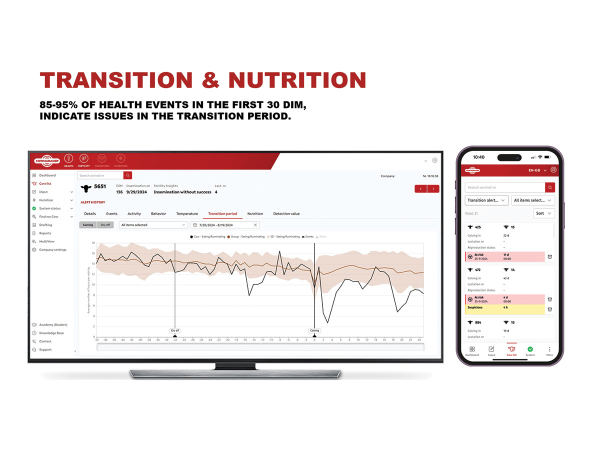
The transition window is where it counts most. If there is one period where this visibility matters most, it is the transition period - the six weeks spanning dry-off through to the early weeks after calving.
Research consistently shows that 85-95% of health events in the first 30 days in milk originate in the transition period - often before a single visible sign appears. Dry matter intake drops. Metabolic demands spike. Subclinical conditions like ketosis and milk fever (hypocalcaemia) develop without obvious outward signs.
Local data from CowManager NZ shows that cows generating more transition alerts tend to produce less milk not just through early lactation, but across the full 300 days in milk - a gap that doesn’t close. They are also more likely to cycle later, a pattern that flows directly into their 6 week in-calf rate, and one that farms using the system have observed consistently.
Those consequences follow a cow through lactation and into mating. That’s a whole season of problems seeded here during dryoff, before calving even begins.
“The calving window is closer than it feels, and the cows that need attention before it arrives are already in your herd.”
Practical monitoring when it counts
CowManager ear sensors run continuously, day and night, across the whole herd. Alerts come through the easy to understand app so your team can prioritise who needs attention, without walking every paddock hoping to spot it.
Your vet still makes the call. But they have more to work with, sooner.
Talk to your local CowManager rep about transition monitoring ahead of this calving season.
cowmanager.co.nz