Feds Welcomes Labour Party Support For Sharemilking Law Review
Federated Farmers says it welcomes Labour's commitment to reviewing the Sharemilking Agreements Act, calling on other major parties to do the same.
 increase font size
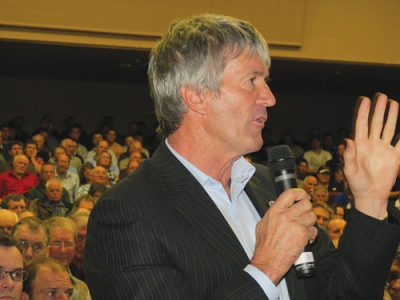 Damien O’Connor.
The farming sector has its head in the sand if it doesn’t realise water is a huge issue waiting to be tackled, says Labour’s primary industries spokesperson Damien O’Connor.
If agricultural organisations like HortNZ or IrrigationNZ “are smart they will show leadership on this issue; if they are dumb, they won’t”, he told Rural News.
“This simply [requires] a user-pays regime where we need to spend money to clean up waterways, to better monitor what is happening with our water management systems and waterways and for more research.”
O’Connor says user-pays, as a principle, has long been acceptable to farmers, but the water issue has been largely ignored for a long time.
“All you have to do is refer to John Luxton’s (former DairyNZ chairman) opinion that for the dairy industry in particular the social licence to operate is quickly evaporating. The industry needs to get ahead of a number of issues.
“A royalty on water would effectively provide funding for storage where it is viable, and for irrigation, better monitoring, research and development and better monitoring of regulations and standards,” O’Connor claims.
“If we don’t do this properly our customers will be rejecting our product. We have to produce the finest, most ethically and sustainably produced products in the world and get a premium for them otherwise our future is not too bright.”
He says a ‘royalty’ would be applied to all commercial use of water except that coming via reticulated supply. However urban and industrial clean-up of waterways are “just as necessary and need to be proceeded with”.
Urban people would also pay for water clean-ups of sewage and stormwater systems, but through a different mechanism, he says.
In rural areas charges wouldn’t be made for stock water but further details “have to be worked through”.
That’s why Labour plans a round-table discussion if elected “because in different parts of New Zealand there are different degrees of reliance on water and different impacts on waterways, as pointed out by Federated Farmers”.
O’Connor also claims that Labour, in Opposition, has not had the resources required to analyse the details sufficiently and properly. He says this is why it is waiting – pending the resources of Government – to establish the finer details of any proposal.
He says if Labour was forced into the detail now it may not be accurate and fair.
“We want to be accurate and fair so that what we implement is workable and people can see it is logical.”
Federated Farmers says it welcomes Labour's commitment to reviewing the Sharemilking Agreements Act, calling on other major parties to do the same.

Red meat farmers are welcoming Labour’s plan to review the Emissions Trading Scheme and not to campaign on pricing agricultural emissions.
For the first time in a quarter of a century, Federated Farmers has something positive to say about the Labour Party’s climate change policy leading into a general election.
James Blair, an agronomist for AS Wilcox and the Pukekohe regional champion, has won the 2026 Young Grower national title.
Blueberries have the potential to become a major horticultural export, earning up to $150 million within the next three to five years.



LIC shareholders have elected a new North Island representative to the co-operative's Board, along with five representatives to its Shareholder Reference Group (SRG), following the company's Annual Meeting held in Invercargill.
Farmers across parts of Southland and South Otago are continuing to deal with difficult conditions after a prolonged run of wet weather, with pressure building around feed supply, stock management, pasture damage, farm infrastructure and everyday workloads.
Federated Farmers says it welcomes Labour's commitment to reviewing the Sharemilking Agreements Act, calling on other major parties to do the same.
For Canterbury dairy farmers Sian Meijer and Rick Wobben, wearable technology has become one of their most valuable on-farm tools - helping manage 1850 cows across an expansive, high-performing dairy operation while improving efficiency, mating outcomes and day-to-day decision making.
Fonterra has unveiled its annual results for the 2026 financial year, posting $27 billion in revenue and close to $20 billion returned to New Zealand farmer owners and unit holders.
The first major update to the Dairy Cattle Code of Welfare in more than a decade has been released, marking what DairyNZ describes as an important step in ensuring animal welfare standards continue to evolve alongside scientific evidence and on-farm realities.