Kuhn Group Sales Dip 9% in 2025 but Orders Signal Recovery
Kuhn Group recorded net sales of NZ$2.27 billion in 2025, finishing around 9% lower than in 2024.
 increase font size
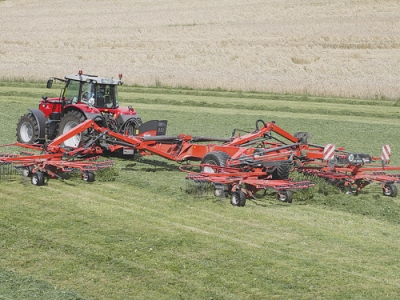 The Kuhn GA 15131 machine, with a working width of 14.7m, should warrant a closer look.
Four-rotor rakes have become the prerequisite for satisfying the enormous appetites of the latest self-propelled forage harvesters and large square balers.
So the launch of the Kuhn GA 15131 machine, with a working width of 14.7m, should warrant a closer look.
Using four 3.65m rotors, with the front pair carrying 13 tine arms and the rear pairs carrying 15, each tine arm is fitted with four tines. These are driven by the Master Drive gearbox, which carries a 200 hour service interval.
Rotors are carried on four pivoting, large diameter wheels and combine with the Kuhn 3D rotor suspension system to ensure good ground following, stability and a clean raking action over the working width, adjustable from 9.50 out to 14.70m.
The machine also has the Kuhn Stabilift system that allows individual rotors to be lowered parallel to the ground, which stops tines digging in and causing soil contamination.
A central windrow can be created with widths from 1.40 to 2.5m, and the VT 50 series control terminal can carry out pre-programmed sequences for effortless headland turns. Additionally, each rotor can be lifted individually for a clean finish or to achieve extra ground clearance in difficult areas or poor terrain.
In work, the raking height is controlled hydraulically from the integral hydraulic drive unit, which also drives the four rotors and offers the option to increase rotor speeds by up to 20% in light crops.
Minimium tractor power requirement is 115hp.
Kuhn Group recorded net sales of NZ$2.27 billion in 2025, finishing around 9% lower than in 2024.
ZED, the dedicated wholesale division of CB Norwood Distributors, and the importer and distributor for Kuhn in New Zealand, has announced investment in local expertise and stock availability for customers in 2026.
Kuhn has announced an expansion of its range of disc mowers, distributed by Norwood in New Zealand, with the addition of two new vertically folding rear mounted models, the GMD 3515 and GMD 4015.
With most forage harvester manufacturers offering machines touching 1000hp, the logistics puzzle has always been ‘dropping” grass and pulling into a swath big enough to feed the “beast”.
French company KUHN has won a EIMA Technical Innovation Award for its Baler Automation Technology.



LIC shareholders have elected a new North Island representative to the co-operative's Board, along with five representatives to its Shareholder Reference Group (SRG), following the company's Annual Meeting held in Invercargill.
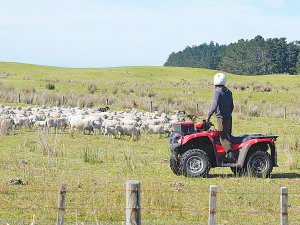
Farmers across parts of Southland and South Otago are continuing to deal with difficult conditions after a prolonged run of wet weather, with pressure building around feed supply, stock management, pasture damage, farm infrastructure and everyday workloads.
Federated Farmers says it welcomes Labour's commitment to reviewing the Sharemilking Agreements Act, calling on other major parties to do the same.
For Canterbury dairy farmers Sian Meijer and Rick Wobben, wearable technology has become one of their most valuable on-farm tools - helping manage 1850 cows across an expansive, high-performing dairy operation while improving efficiency, mating outcomes and day-to-day decision making.
Fonterra has unveiled its annual results for the 2026 financial year, posting $27 billion in revenue and close to $20 billion returned to New Zealand farmer owners and unit holders.
The first major update to the Dairy Cattle Code of Welfare in more than a decade has been released, marking what DairyNZ describes as an important step in ensuring animal welfare standards continue to evolve alongside scientific evidence and on-farm realities.




