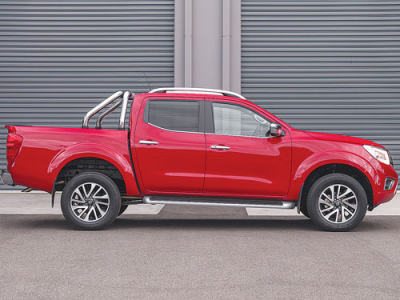
Recently we spent a day testing out the new rear suspension upgrades to the Nissan Navara on Australian roads. Now we've tested it in New Zealand.
At the launch, we drove it with weight in the tray and then with a decently heavy trailer. Nissan wanted the focus to be on the improved performance of the rear end under load. The general consensus was the Navara passed that test, no worries.
In any given week, the average ute does as many, if not more, miles with little or no weight on the tray or towbar than it does loaded to capacity, so unladen ride comfort and general liveability are important measures too.
Nissan’s claim that the new dual-rate rear springs actually improve ride comfort stands up. Expectations about ride comfort in a ute have evolved with VW and Ford raising standards to new levels in recent years. The Navara doesn’t quite match those two, but the ride is still very good.
Allied with a quicker steering rack, the Nissan chassis also goes around the bends better and with less arm action.
It will hold its line when punted through a corner and is not thrown by mid corner bumps. It’s a relaxing drive and, some diesel rattle aside, it is quiet.
Equipment levels in the ST-X version we drove have been enhanced with 360-degree bird’s eye view displayed on a 7 inch monitor and satellite navigation built in. Two ISOFix child restraint mounting points have been added to the rear seat.
The 2.3L twin turbo diesel remains unchanged – no bad thing – and the 450Nm maximum torque available from just 1500rpm, delivered via a 7-speed automatic, makes for a smooth and capable power-train. A 6-speed manual is also available.
The ST-X double cab auto, as tested, retails at $64,490. The suspension changes also apply across the double cab SL and ST grades though, and you can get into a 2WD ST for $47,290.