Federated Farmers Welcomes ACT’s New Farming Policies
Federated Farmers has welcomed new rural policies released by ACT, saying they align closely with its own election priorities.
 increase font size
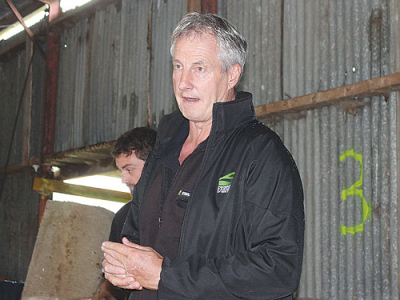 Federated Farmers Auckland president Andrew Maclean.
Some youngsters working recently in farm flood recovery via a Ministry for Social Development scheme have got received on those farms, says Andrew Maclean, Auckland provincial president, Federated Farmers.
Maclean visited a DairyNZ autumn discussion meeting in Clevedon last week to tell the farmers about this service.
Primary Industries Minister Nathan Guy in March officially classified the storm damage in that area, and in Hauraki and Thames-Coromandel districts, as a medium scale adverse event.
Clevedon and nearby Orere Pt and Kawakawa Bay were hit hard by floods in mid-March, with stock drowned and and horses seen on the internet finding their own way to safety.
Maclean says some youngsters on Taskforce Green work squads for flood recovery ended up getting jobs. He knows this from experience elsewhere.
“And farmers [in Clevedon] have told me exceptional youngsters among them will be offered work beyond the organised programme.”
He said an offer has come from the government, since Nathan Guy’s recent visit, to provide groups of youngsters to help with flood recovery. They would help repair fences and gates, clear debris from fields and do other work.
About half a dozen farmers in Clevedon, Kawakawa Bay and Orere Point have shown interest in such help.
Maclean asked the farmers attending to tell him if others need help.
“Also, it is not [limited to] physical help on farm [but can be extended to] people who are clearly suffering from that event. We are here to help and channel services to those people.”
He also urged farmers to draft health and safety plans, saying if they don’t already have them they should speak to their Federated Farmers representative.
Further explaining to Dairy News about the work squads, Maclean said they have been available in other regions following storms. Resources are being put together to help people who have suffered serious damage to their properties and don’t have enough resource themselves to fix them.
Auckland areas Clevedon, Kawakawa Bay and Orere Point were especially hard-hit by floods recently, as was Coromandel.
“The Rural Support Trust is co-ordinating needs assessment and the people coming out to help, who will mainly be youngsters,” he says.
“On properties they are putting in teams of six plus a supervisor for two days for a start. [The teams] get around half a dozen farms for a start and if there is more work to do they go back to the start.
“They come from the Ministry for Social Development so are on benefits or between jobs – a mixture of different circumstances. “Some have farm experience, and they will have a supervisor with them – that is critical -- who will definitely have some farm experience.”
Federated Farmers has welcomed new rural policies released by ACT, saying they align closely with its own election priorities.
Federated Farmers is backing Feilding High School’s call to keep Agriculture and Horticultural Science as a standalone subject in Year 11.
National’s pledge to introduce 19 new national standards shows the party is serious about getting Wellington out of farming, Federated Farmers says.
Today, 15 October, is the International Day of Rural Women, which recognises rural women’s contribution to farming, communities and the environment.
Mobile phone coverage and reliability are deteriorating in rural areas, and farming families are bearing the cost, according to a Federated Farmers survey.


Federated Farmers has welcomed new rural policies released by ACT, saying they align closely with its own election priorities.

Rural Contractors NZ says proposed changes to land transport rules for agricultural vehicles are a welcome response by the Government to out of date regulations which have seen members hit with huge fines.
Alliance is calling for final applications for its 2027 Graduate Programme, with applications closing on Sunday 25 October.
Decades piloting planes has ensured vet and farmer David Hayes is focused on safety. So, after a serious accident while welding on farm, he is sharing his experience so others can learn from it.
Canterbury milk processor, Synlait Milk has confirmed Leon Fung as its chief executive officer.
OPINION: Making it easier to collect rainwater and use it to grow crops and livestock is a no brainer.