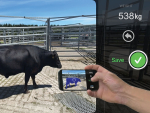
Innovation Awards 2026 Winners Showcase Primary Sector Ingenuity
The bright ideas of New Zealand's primary sector have been celebrated with an announcement of the winners of the 2026 Innovation Awards.




 increase font size
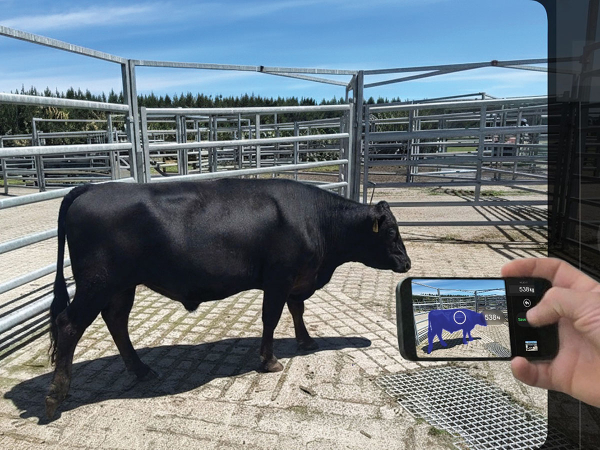 Farmers can determine the live weight of cattle using the LiDAR sensor on an iPhone.
Unlike dairy farming where real-time data is widely used to manage production, much of the beef industry still relies on estimation when assessing livestock weight.
Traditionally, cattle are mustered into yards and processed through weigh platforms, a process often time-consuming, labour intensive and stressful for the animals. In addition, systems can be costly and require purpose-built yards and races, while some research suggests that the stress of yarding can even result in short-term weight loss, making frequent weighing counterproductive.
NZ Agritech start-up company Scanabull has built a computer-vision platform that allows meat processors and farmers to determine the live weight of cattle using the LiDAR sensor on an iPhone. The technology captures a 3D scan of the animal and processes it using proprietary neural networks run directly on the device. Promising to weigh cattle in one second without the crush or guesswork, the technology provides meat processors and farmers with accurate real-time data about on-farm production.
The company has recently announced a NZ$1.1 million raise led by Sprout Agritech, with support from Enterprise Angels and Callaghan Innovation’s Deep Tech Incubator programme. The company is already working with industry partners including Silver Fern Farms, with trials and demonstrations underway across New Zealand, and will actively explore opportunities in Australia and other major beef-producing regions by year-end.
Scanabull uses a phone app for an iPhone Pro and a custom camera called the Scanabull Weigh Point that weighs animals automatically in the paddock. The phone app offers a quick measure of an animal’s weight, while the Weigh Point allows better measurement of growth trends.
On a practical front, farmers, stock agents and veterinarians can scan animals directly in yards, pens or near farm gates using their smartphone, offering a quick and low-stress way to monitor livestock performance without needing expensive weight platforms and specialised infrastructure. In addition, the system will also be able give meat processors access to valuable supply chain data to improve the efficiency of their operations. Future versions will extend beyond live weight measurement to include additional metrics such as carcass weight prediction and body condition scoring.
Co-founder and CEO Dan Bull, who grew up on a farm and spent several years actively managing livestock, says this lack of accurate data can create costly inefficiencies across the supply chain.
“Many animals are bought and sold based on visual estimates rather than objective measurements. When those estimates are wrong, it can result in significant financial differences for farmers, traders and processors,” explains Bull. “Our goal is to give the beef industry a fast, reliable way to understand what’s actually happening with their animals in real time.”
The bright ideas of New Zealand's primary sector have been celebrated with an announcement of the winners of the 2026 Innovation Awards.


A spate of southerly winds bringing cold temperatures has presented challenges for Taranaki dairy farmers.
Converting a longstanding cropping farm to dairy was the only way to ensure the land stayed in the family long term, says new dairy farmer Rod May.
As the election heats up, Organics Aotearoa New Zealand (OANZ) has launched its election scorecard designed to help voters wanting to support policies that grow organic and New Zealand's organic sector.
A 'tsunami' of milk from key exporting countries is winding down and this may be good news for New Zealand dairy farmers.
Will the good times last? That's one of the key issues to come out of the latest Federated Farmers confidence survey.
Outgoing Fonterra Co-operative Council chair John Stevenson says that it has been a privilege to represent the co-op's farmer shareholders.



OPINION: It seems Canterbury processor Synlait is still in the doldrums.
OPINION: Get offside with New Zealand First leader Winston Peters at your own peril.




