
Ex-All Black Sam Whitelock Swaps Rugby for Dairy Farming
Returning to the family dairy farm after playing 20 years of professional rugby around the world is no easy task.




 increase font size
 Gareth Hale says JD technology has delivered some of the biggest productivity gains.
Gareth Hale is the current custodian of a 160-year legacy that saw his great grandfather dairying in Taranaki since the mid-1850s and grandfather dairying in the Waikato from the early 1900s.
When asked what he hopes to leave behind, the simple answer is something for the kids to carry on.
Today, Gareth is continuing that legacy in the South- and Mid-Canterbury regions, having spent the past 25 years building a large-scale dairy operation that began with about 160 hectares and 500 Jersey cows, growing into a 125-ha operation, milking about 2600 cows across three farms. The operation also crops about 400ha each year, growing winter feed, barley silage, maize, grass silage, kale and other feed crops.
Targeting 500 to 550kg milksolids per cow, feed quality underpins the operation, crops need to be planted on time, fertiliser applied when conditions allow, and silage harvested while quality is at its peak.
“With double cropping, the pressure is even tighter. When the day one crop comes out, you want the tractor on the paddock ready to do the next crop,” says Hale.
Defying the premise that dairy farmers would rather buy cows than machinery, John Deere 6 Series tractors are the preferred brand across the business, from smaller units suited to dairy operations, to higher-horsepower machines used for heavier cultivation.
“When we went to John Deere, maintenance was probably about a quarter of what it had been running previous brands,” he said. “With 20 staff, it’s costing money if your machines don’t work when you turn the key.”
Alongside reliability, Hale says JD technology has delivered some of the biggest productivity gains, with guidance systems, including GreenStar and AutoTrac, used to improve accuracy, reduce overlap and make better use of time, fuel and inputs.
“GPS has made a massive difference with our cropping,” he says. “Every time, you know you’re not overlapping and you’re not wasting diesel.”
John Deere Operations Center also helps the business to bring machine, job and paddock information into one place, from fuel use, idle time and area worked, to service records and machine alerts.
“Going forward, we should be able to get accurate numbers and know the fuel usage and real-time data,” says Hale.
In a tightly timed operation where a missed window can cost yield, Hale says the local dealership team had become an important part of the value behind the machinery.
Drummond and Etheridge representative Neil Paver, a Large Ag Sales Specialist, said the John Deere Operations Center has added another layer to the support.
“The system gives us a quicker diagnostic time, meaning when we go out to the job, we know what’s going on and not just flying in the dark,” Paver said.
Looking ahead, for Hale, the future of dairy farming will be shaped by further advances in technology, including more efficiency with GPS, variable rate spreading fertiliser and spraying – all combining to save on costs.
“The technology may be changing, but the goal remains the same-leaving behind a business that can be carried on-hopefully for another 160 years,” says Gareth Hale.
Returning to the family dairy farm after playing 20 years of professional rugby around the world is no easy task.
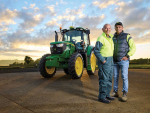
The 2026 delivery of their thirteenth John Deere tractor marks a relationship with the brand that goes back over 40 years, in a business that was first registered in 1963 and a family enterprise that dates back over one hundred years.
A long way from when AI meant plunging a plastic-covered arm armpit deep up a cow’s rear, John Deere has shown off its new artificial intelligence (AI) assistant, aptly called JD, which aims to simplify data processing on farms.
Leading John Deere technicians and apprentices from New Zealand and Australians were recognised at the recent sixth annual JD Technician of the Year Awards, held in Brisbane.
In Dacre, near Invercargill in New Zealand’s South Island, Bruce Dinnington is running a dairy operation unlike any other.

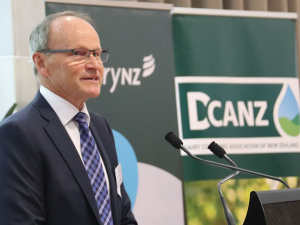
Dairy processors are ready to further boost New Zealand’s export earnings but want the incoming government to match their ambition with good policy.
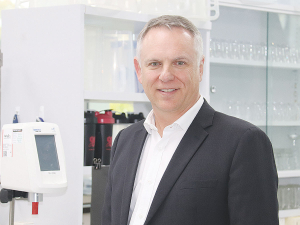
Massey University is best placed to solve the “problems” facing the dairy industry, says vice chancellor, Pierre Venter.
Synlait's longest serving employee – a man who joined the Canterbury-based milk processor even before it began processing milk – is now its newest executive.
A dairy industry leader believes eradicating the common and costly disease, Bovine Viral Diarrhoea (BVD) is within reach.
A farmgate milk price of $10/kgMS this season is firming up as milk powder prices soar and the New Zealand dollar weakens.
Federated Farmers has welcomed new rural policies released by ACT, saying they align closely with its own election priorities.

OPINION: It seems Canterbury processor Synlait is still in the doldrums.
OPINION: Get offside with New Zealand First leader Winston Peters at your own peril.




