New Synlait CEO Leon Fung Commits to Christchurch Move
Canterbury milk processor Synlait has come through tough times and is now ready to scale up from a stable base, says its newly confirmed CEO Leon Fung.




 increase font size
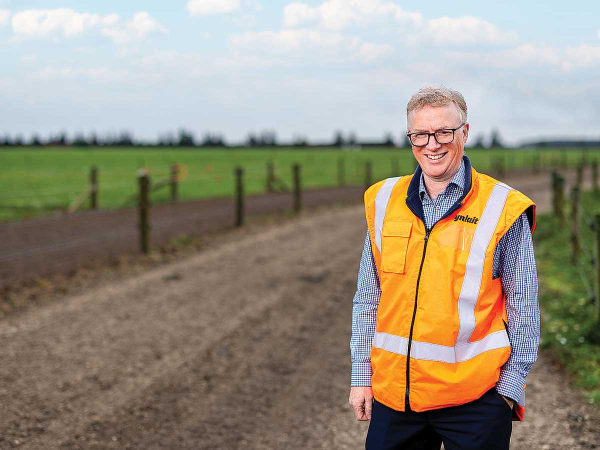 David Williams
Synlait's longest serving employee – a man who joined the Canterbury-based milk processor even before it began processing milk – is now its newest executive.
David Williams has been appointed general manager of milk supply and sustainability, in charge of the team of 28 people which runs Synlait’s two commercial dairy farms, supports its nearly 200 farmer suppliers and leads its sustainability workstreams.
Williams jointed Synlait in March 2008 when the Dunsandel company was primarily a dairy farm owner and its first processing plant was still under construction.
At that time, he explains, the company had nine dairy farms, was in the process of converting another six for the following season, and the company’s Dunsandel plant was still being kitted out with the first drier due to come online in August 2008. In the 2008-09 season it began processing milk from 60 farms, its own 15 plus another 45 contracted suppliers.
“My role back then was everything to do with milk supply. I was it,” he told Dairy News.
“Everything to do with all the relationships with farmers and contracting the milk, and all of the aspects relating to milk quality and RMP [Risk Management Programme] and sustainability, and all of the milk collection.
“So, I started in March 2008, and there was quite a lot to do before August.”
Williams’ elevation to the executive this year comes as the company is coming out of a difficult period, having reported a net loss after tax of $75.4 million for the year to July 31 2026 – but that includes a sharp turnaround of a net loss of $80.6 million for the first half of the financial year, then a net profit of $5.2 million in the second half.
Williams says the company’s recent problems have been met by reinvestment by shareholders Bright Dairy and A2 Milk, and by refocusing operations on the Dunsandel plant, with all suppliers now in Canterbury.
Williams says Synlait has had its ups and downs, but he has stayed through the tough times because he likes the company, what it stands for, and that it has always attracted “really good people who just want to get on with things”.
He adds he also enjoys working with the farmer suppliers, who have also shown their loyalty to the company.
“Most of the ones that started in 2008 are still there as well.”
Canterbury milk processor Synlait has come through tough times and is now ready to scale up from a stable base, says its newly confirmed CEO Leon Fung.

With New Zealand’s greenhouse gas emissions in the spotlight, Auckland scientist Nathan Balasingham says there’s a better way to tackle the problem than shrinking cow numbers or fertiliser usage.
Canterbury milk processor, Synlait Milk has confirmed Leon Fung as its chief executive officer.
I am often asked by industry people, what are the options for removing a grapevine without producing a phytosanitary problem? Can it be done sustainably? What will it cost me?
Waikato milk processor Tatua has again declared a record milk payout to farmer shareholders, leaving other processors in the dust.

For 15 years, Glenda Rees has travelled from Gore to Awarua, often several times a week, to keep watch over one of the country’s rarest birds.
With some farmers opposing a government-industry partnership set up to develop methane reducing products, one NZ company claims that it already has a product on the market.
During the nesting season, from September to December, industrious starlings can quickly build nests in the darker areas behind tractor and vehicle, usually close to hot engines, typically resulting in localised damage or in some cases complete write-offs.
The meat processing industry is much more collegial than it was in the past and is now more focused on common goals.
With the last couple of months having seen some potential tractor purchases put on hold with the impending election and continued input cost rises, year-to-date figures, ending September, has seen deliveries up around 5% over the same period in 2025, with a total of 2026 units.
Beef+Lamb New Zealand is calling for nominations for director roles in the Northern South Island and Northern North Island electoral districts.
OPINION: It seems Canterbury processor Synlait is still in the doldrums.
OPINION: Get offside with New Zealand First leader Winston Peters at your own peril.