fbpx
Print this page
Wednesday, 20 September 2023 11:55

Fliegl Cargos – not just about grass harvesting

Written by  Mark Daniel
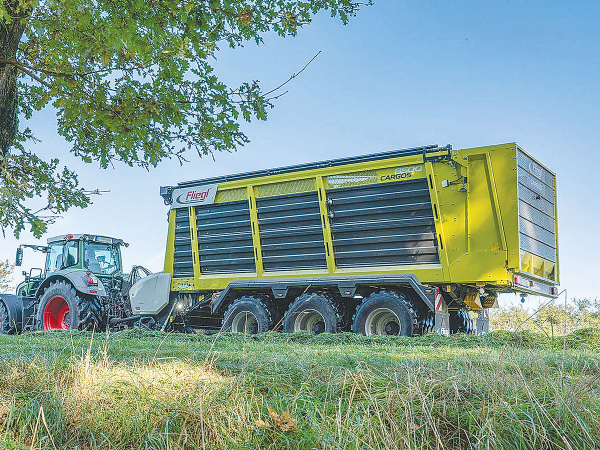
Fliegl sees the machines as multi-taskers. Fliegl sees the machines as multi-taskers.

Back in 2022, Claas announced the sale of its Cargos self-loading wagons to Bavarian company, Fliegl, suggesting that the market for such wagons was static, with too many players vying for the limited business and a pressing need for more room at its Bad Saulgau factory.

Not wishing to appear that it might be leaving its customers in the lurch, there needed to be an established need for parts and service into the future, so Fliegl was an ideal buyer, given that it already produced tipping and push-off trailers, alongside manure spreaders and slurry tankers.

During an agreed transitional period, Fliegl received the rights to use the Cargos name and Claas livery, with Claas committed to continue to help Fliegl build and develop the product line.

Now that Fliegl is selling the machines, there appears to be a change of emphasis in their use. During its tenure under Claas, the Cargos series was marketed under the company’s grassland range, perhaps with some additional transport work. Fliegl sees the machines as multi-taskers that can obviously be a forage wagon, or with the pick-up and chopper mechanism removed, as a general-purpose trailer, with a moving floor, for haulage tasks.

To this end, Fliegl suggests that the trailers might even be at home in the timber industry or on farms, where they might cart grass from alongside a forage harvester or grain away from a combine harvester.

This flexibility could well be the secret success in what was deemed to be a static market, as other loader wagon manufacturers are focusing on the grass harvesting aspect, while Fliegl builds on its vast experience in the transport sector.

Offered in three ranges, the Cargos 700, 8000 and 9000 series offer capacities of 21 to 59.5 cubic metres capacity. The 700 series is a transport-only model that utilises a moving floor for discharge. The 8000 and 9000 series feature a removable pick-up/chopping unit with 40 reversible knives that is easily converted for transport duties, with up to three extra tonnes capacity, when the harvesting unit is removed.

A range of options include axle configurations, joystick steering functions, fully automated loading and discharge and ISOBUS connectivity.

More like this

New CLAAS Swath Turner Fixes Twin-Rotor's Blind Spot

Twin rotor swathers have become the ‘go-to’ for forming swaths to feed hungry harvesters and balers, however, the design layout often means that crop located between the two rotors is not picked up, turned over or incorporated into the swath formed for subsequent harvesting.

Motueka Farm Machinery Sold as Sturgeons Retire After 44 Years

Close to the Abel Tasman and Kahurangi National Parks, Motueka is known for apples, pear and kiwifruit orchards, alongside specialised crops such as hops. Indeed, that specialisation, saw the area being the New Zealand centre of the tobacco growing, until the early 1980s.

Can-Am Unveils 2027 SSV, ATV Range With New Defender HD10

Can-Am has introduced its 2027 range of side-by-side vehicles (SSV) and all-terrain vehicles (ATV), including the industry leading Defender, the Maverick R and the hugely capable Outlander ATV, incorporating a host of advancements designed to deliver an exceptional riding experience.

Featured

Southland Farmers Face Wet Weather Toll, Support Available

Farmers across parts of Southland and South Otago are continuing to deal with difficult conditions after a prolonged run of wet weather, with pressure building around feed supply, stock management, pasture damage, farm infrastructure and everyday workloads.

How Wearable Tech Powers This 1,850-Cow Dairy Farm

For Canterbury dairy farmers Sian Meijer and Rick Wobben, wearable technology has become one of their most valuable on-farm tools - helping manage 1850 cows across an expansive, high-performing dairy operation while improving efficiency, mating outcomes and day-to-day decision making.

New Dairy Welfare Code Released, Takes Effect 2027

The first major update to the Dairy Cattle Code of Welfare in more than a decade has been released, marking what DairyNZ describes as an important step in ensuring animal welfare standards continue to evolve alongside scientific evidence and on-farm realities.

National

Machinery & Products