Having built a strong reputation in the materials handling sector since 2002, Sri Lankan headquartered GRI Tyres made a move into the agricultural and construction markets in 2018.
The company now operates in 17 countries with 1,400 staff, manufacturing their products using pure sustainably grown rubber.
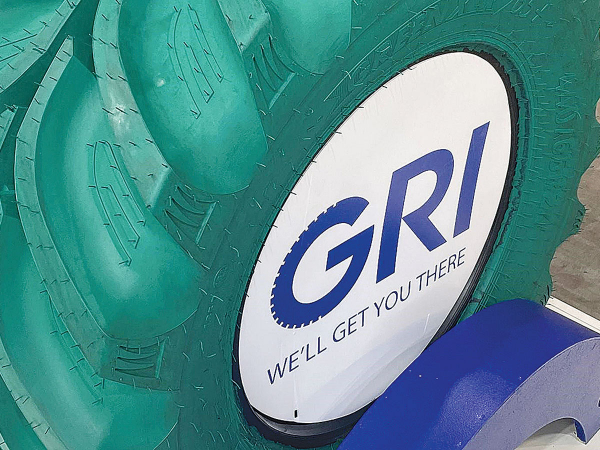
While it has long been the case that round and black are the standard shape and colour for all tyres, GRI has brought a little bling into the game, with their recently released ‘Earth’ range of tyres, which as the name suggests are actually green.
For now, there are two ranges, namely the ‘Green Earth XLR 65+’ and the ‘Green Earth XLR 65’ – the latter represented by a 650/65 R38 size tyre. But it is not just the colour that makes the 65+ range interesting, it also sports an unusual lug pattern.
Said to offer improved on-road added stability, a longer service life and reduced vibration, unlike traditional tread bar layouts, the Green Earth treads do not overlap in the middle of the tyre. Instead, they are angled and run alongside one another, creating a “virtual rib” so more of the lug is in contact with the ground.
In addition, the innovative curve of the lug angle at the centre is said to have been designed for improved fuel efficiency and greater off-road traction.
Bipin Singh, general manager for sales and marketing at GRI, explains that 42% of the green tyres are made using sustainable materials such as biomass and recycled products, coloured green to make them stand out. This green colour is not a coating, it is part of the compound, so the tyres will remain green throughout their service life.
The tyres are built with pure natural rubber, highly dispersible silica, recycled carbon black, and reclaimed rubber from used tires. Natural soybean oil, which is a sustainable material, has also been used instead of petroleum-based oil, and the carbon footprint has been reduced as it is produced using bio-sourced and recycled materials.