fbpx
Print this page
Friday, 08 September 2023 11:55

Rake built for tramlines prevent soil compaction

Written by  Mark Daniel
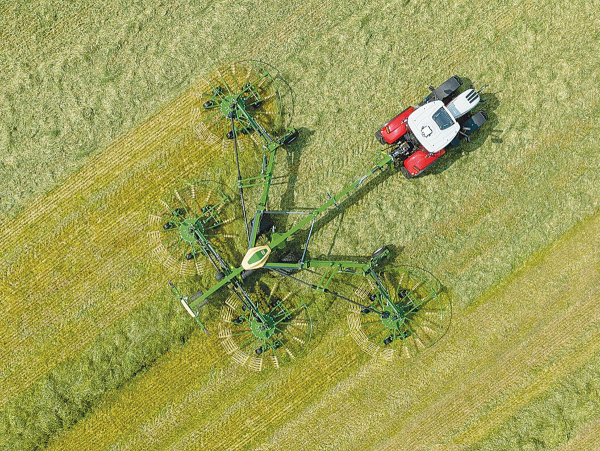
The Swadro TC1570 four-rotor centredelivery rake is said to be an ideal fit for highways in paddocks. The Swadro TC1570 four-rotor centredelivery rake is said to be an ideal fit for highways in paddocks.

Controlled Traffic Farming (TCF) systems see arable operators, using tramlines as “highways” for moving through a crop.

Then, use machinery with specific operating widths to ensure there is no need to move off these tracks, thereby limiting compaction to the tramlines, rather than across the whole paddock.

While CTF has never really been used in dairy operations, German manufacturer Krone suggests this is changing as forward-thinking dairy farmers strive to limit compaction, particularly in wetter seasons.

The company suggests that with a maximum working width of 15.70m, the Swadro TC1570 four-rotor centredelivery rake is said to be an ideal fit for such operations.

Wider than the existing four-rotor TC1370, the V-frame concept on the newcomer is said to be an adapted version of the six-rotor TC2000.

Featuring 15 tine arms on each of the rotors, the mechanical driveline sees the front two rotors rotating about 25% faster than the rear units, which the company suggests promotes optimum forage flow through the machine to create tangle-free, box-shaped swaths. Operated via an ISObus terminal or in combination with an ISObus joystick, overall working width is adjusted by the two front rotor arms, while final swath wide of 1.40 to 2.90 metres is hydraulically adjusted via the rear pair of rotors.

The main frame can be lowered hydraulically to reduce the transport height to below 4.0m without the need to fold or remove any tine arms. The transport chassis is equipped with 710/40 R22.5 tyres as standard, or optional 800/35 R22.5 units, while infield stability is improved with the use of wide 16 x 9.50-8 tyres on the fourwheel rotor chassis’ and the 15/55-17 support wheels on the two front arms.

Electric height adjustment allows individual or simultaneous rotor adjustment, will the choice of two preselected heights to be saved on the terminal and activated at the touch of a button.

At headlands, the rotors can be set to lift just over existing swaths, while the lift delay of the rear rotors is also adjustable, and the automatic Soft- Down mechanism slows the speed of lowering just before the rotors touch down. Section control is also available to lift/lower the rotors automatically using GPS.

More like this

Tractor Sales Fall in Most Major Markets Ahead of EIMA 2026

The market is in decline in the United States, Canada and Brazil. In Europe, sales are falling in Germany, France and Spain. Turkey is experiencing a sharp decline, whilst the economic strategies and policies implemented by India and China are driving purchases in both countries.

Waikato Dairy Family Uses John Deere Precision Tech

Areare Farms, a dairy operation in the Waikato region spanning multiple properties and milking 760 cows, now has Jenna and her brother Brian Rogers, the third generation of the family business, working alongside their parents Phil and Jackie.

SAM e-Spreader Now Connects Directly to Tabula

Hamilton-based manufacturer SAM Machinery and Hawke’s Bay’s Tabula have joined forces to offer customers more ways to connect its spreaders with the technology they already use in the cab.

Claas Balers Turn 30

Claas built its first variable chamber round baler - the Variant 100 - in 1996, so 2026 marks 30 years and the fifth generation of the Variant name, recently complemented by the new Cerex Series introduced in 2025.

Featured

Students' Strobe Light Targets Nesting Birds in Tractors

During the nesting season, from September to December, industrious starlings can quickly build nests in the darker areas behind tractor and vehicle, usually close to hot engines, typically resulting in localised damage or in some cases complete write-offs.

NZ Tractor Deliveries Up 5% Year to Date to September

With the last couple of months having seen some potential tractor purchases put on hold with the impending election and continued input cost rises, year-to-date figures, ending September, has seen deliveries up around 5% over the same period in 2025, with a total of 2026 units.

MPI's Diana Reaich on Non-Tariff Barriers and Trade Access

The head of the Ministry for Primary Industries (MPI) trade and international relations group says New Zealand is well-positioned to secure trade access and compete internationally as the world becomes more complicated, demanding and uncertain.

National

Machinery & Products