El Niño Warning: NZ Farmers Urged to Plan Fert Early
Plan ahead and be patient. That’s the message to farmers and horticulturalists from the chairman of the NZ Agricultural Aviation Association, Kent Weir.




 increase font size
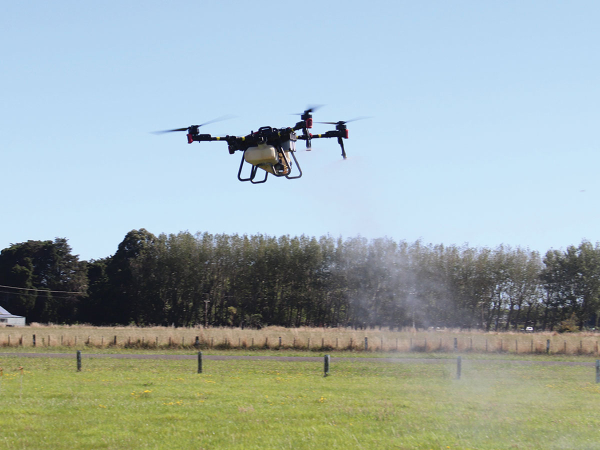 A drone spraying demonstration at the event.
We are not a bunch of sky cowboys. That was one of the key messages from the chairperson of the NZ Agricultural Aviation Association (NZAAA) Kent Weir, speaking at an education day at Feilding aerodrome for 25 policymakers and regulators from central and local government and other rural professionals.
The day consisted of a series of demonstrations involving a fixed wing top dressing aircraft spreading fertiliser, a drone doing a spraying demonstration and a ground spreader. Their respective loads were dropped over specially laid out monitoring equipment to demonstrate just how accurately fertiliser and sprays are delivered on farm.
This was one of the important facets of the day, being further proof of the accuracy of aerial application on a property. Those attending the workshop spent considerable time looking at the results of the patter testing. Travis Hill, who runs a company that carries out pattern testing and calibration, says it's all about the operator showing the client that they are doing a good job.
After lunch the group heard from several experts associated with the aviation industry about the importance of having rules that are practical but that don't compromise environmental standards.
Weir, an ag pilot who did the topdressing demonstration, says the aim of the day was to get the people who write the rules and regulations to see just what happens in the field and the massive amount of technology that is now used to spray and top-dress more efficiently and effectively.
According to Weir, technology has moved with the times. He says there have been massive changes in the way that the industry operates. Gone are the days when a pilot just opened the hopper and let the fertiliser go as they crossed over the farmers' boundary fence.
"It's no longer a hit and miss affair. A sophisticated GPS system in the cockpit of the aircraft controls when and to what extent the hopper doors are to be opened, and precisely determines exactly where the load is to be dropped.
"This means that sensitive areas such as waterways, wetlands and houses are meticulously avoided and the right amount of fertiliser goes on that part of a paddock that the farmers want it to go," he says.
The precision that occurs in the field is driven by the combined actions of the fert rep, the farmer and ag operator and a map of the property. The farmer feeds into a computer the nature of their business, what they want the fertiliser to achieve and then, with input from the fert rep’, decide what product and how much of it they want, and then set a final budget. This file is then sent to the ag operator who checks it out and then feeds this into the very sophisticated GPS system in the cockpit of the aircraft.
Weir says he doubts many of those who make the rules and regulations are fully aware of the advanced technology the ag aviation industry is using and few will have actually seen a topdressing operation out in the field. He says he doesn’t blame the regulators for this and believes the industry itself has not done a good enough job explaining to them and the media just what they are doing.
“We are determined to change this and work positively with the policy makers and regulators,” he says.
 |
|---|
|
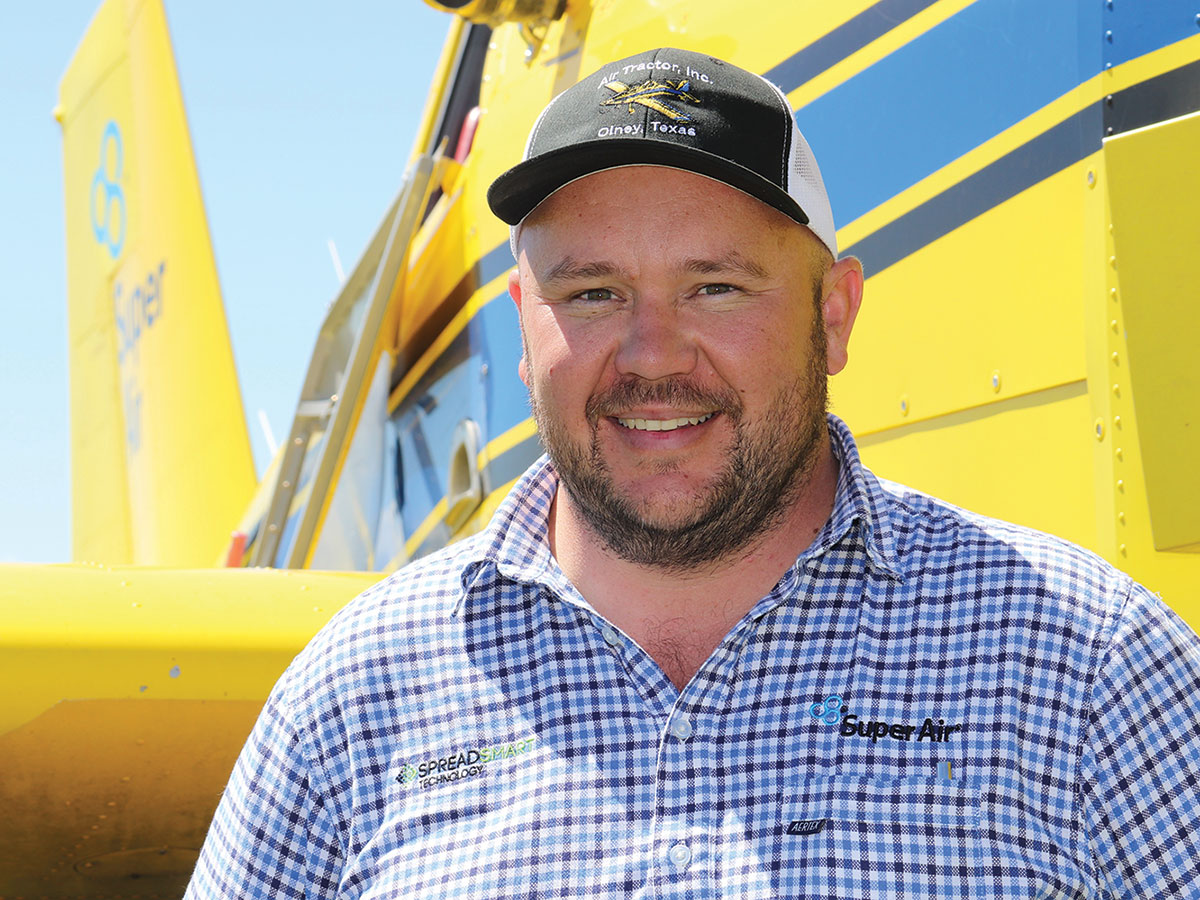
NZ Agricultural Aviation Association chair Kent Weir. |
The Cost
When the first top dressing operations began in the late 1940s the aircraft of choice was the Tiger Moth – a very basic pre-WWII training aircraft that was affordable. Fast forward to 2026 and a new Air Tractor – the type that Kent Weir flew at Feilding – and you are looking at about $4 million, if you could buy it. It’s the cost of this aircraft and its ongoing maintenance that has to be recouped from the farmer.
“Everything comes back to an hourly rate that we as operators have to achieve to run our business,” he says.
But while costs may appear high, the high-tech systems in the modern aircraft ensure that fertiliser is not wasted and if there are good airstrips and other facilities on a farm, the cost of spreading a tonne of fert will go down.
Building Ties
The executive officer of the Ag Aviation Group, Tony Michelle, says the day presented a unique opportunity to build relationships with key people whose decisions impact on the sector. He says it’s important that out of this day there will emerge some vital ongoing relationships and says more events like this one will be held.
“The reason for this is that in most agencies that we deal with, people change and we need to brief new people who come into roles that affect us,” he says.
Michelle says it’s important for the aviation sector that people who are writing the rules fully understand the implications and subtleties of such regulations and the serious consequences of these if they are wrong. He says many of the people they deal with are not aware of the technology that they use every day and having them see this in action was invaluable.
Plan ahead and be patient. That’s the message to farmers and horticulturalists from the chairman of the NZ Agricultural Aviation Association, Kent Weir.

A warning to farmers and topdressing pilots to take extra care as Christmas approaches.
The FMG Young Farmer of the Year 2022 contest will be kicking off on 9 October 2021 for the new season’s qualifying rounds.
Top dressing today is pretty much at the same level as it was pre-Covid, according to the Agricultural Aviation Association (AAA).
John and Janet Spence are unique in the agricultural aviation scene in New Zealand.


Safer Farms is urging farmers to make sure everyone working on farm has safe, suitable footwear for the job.

The Government is backing work on a community-led water storage scheme that could irrigate up to 11,000 more hectares of the Poverty Bay flats, Agriculture Minister Todd McClay says.
Agri-tech company Herd-i has become a new all-region sponsor of the New Zealand Dairy Industry Awards (NZDIA), the largest nationwide celebration of excellence in the dairy sector.
Four candidates have been confirmed for two director positions on Fonterra’s board.
Returning to the family dairy farm after playing 20 years of professional rugby around the world is no easy task.
After delivering another record farmgate milk price to 100 supplying farms, independent milk processor Tatua is entering thee new financial year with a positive outlook.


OPINION: The same mainstream media muppets that brought you Jacindamania in 2017 have been flat out pimping for the Opportunities…
OPINION: Your old mate reckons the atrocious way farmers in the UK are treated by their lords and masters in…




