
NZ Apple Sector Pushes for Japan & Korea Market Access
The apple sector is working with the Government to unlock access to two key markets that could bring millions in revenue for apple growers.
 increase font size
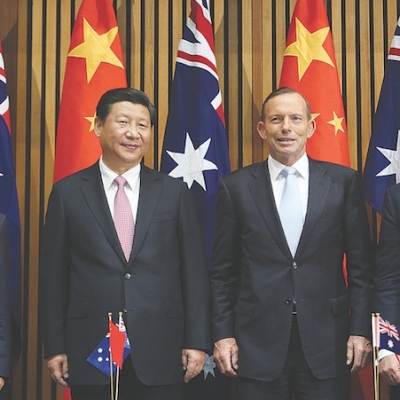 Prime Minister Tony Abbot and Chinese President Xi Jingpin
A BIG fanfare about the recent signing of the free trade agreement between Australia and China includes the hope that China will be the main destination for Australian dairy exports in the next 10 years.
The fine print of the FTA shows our dairy producers will get tariff free access to the all-important infant formula market in four years, and all other dairy products within 11 years. What does this mean to the average dairy farmer in the next three years? Nothing.
When we review previous FTAs with other countries, there has actually been a drop of exports to those countries, not an increase.
Today’s growth will come as export heifers, and good quality heifers at that. As a dairy farmer, you should consider China as your number one destination for dairy heifers, as the returns can be up to 50% higher than from Australian buyers.
China can become self-sufficient in dairy within five years, and a competitor on world markets within ten years. They have the technology, land, climate and feed to become a dominant player.
For every dairy cow in Australia, there are nine dairy cows in China, and each year China imports more cows. Australia exports large numbers of cows, at better returns than farmers would receive in Australia. If it wasn’t Australia exporting cows there, it would be other countries – New Zealand, US, Canada and the northern hemisphere.
China’s demand for dairy is increasing but it is along generational lines. Overnight change to dairy from rice-based meals will not occur. It will be a generational change, starting in China with infant formula, on which tariffs will not be reduced for four years.
As the next generation in China grows, they will start buying more dairy product, but it will take years.
Chinese tastes are so different from Australians’ that it will be difficult to achieve same-product manufacture. We have to design foods for Chinese tastes, not Australian tastes.
Over 95% of all liquid milk in China is bought as UHT milk, which is the opposite to Australia where fresh milk makes up 95% of our sales. The distribution channels in China, cumbersome and difficult, will not favour fresh milk. A lot of product is delivered on bikes; road congestion is massive.
Companies intent on entering China in the next four years must form close alliances with Chinese dairy companies. Most prefer a 50/50 joint venture, and by joining with a Chinese company you get local market access, local customers, distribution and recognition of our branding.
Over the next four years, Australian dairy companies simply need to grasp joint ventures with open arms in many a different province and stick with successful standard Australian dairy brands.
Joint ventures will help grow these brands in China and as China continues to become a competitor on the global marketplace, our brands can be used in China under license where companies can grow their income, be it from locally made product in Australia, or product made in China using our names. Joint ventures also eliminate the problem of dealing with too many traders, who take a cut on the way through, to the detriment of returns to farmers.
Manufacturers will need to also ensure tight control of their trademarked names. Many Australians have bought fake Chinese products knowing full well they are fake.
Australia is a small fish in a big pond in the global dairy market. Instead of trading in commodities that are turned into other products in other countries, we should target more growth of finished products with a longer shelf life, including UHT milk, infant formula, ice cream and yoghurt.
In Hong Kong recently I had great pleasure in seeing Pauls Custard and a good range of Bulla Dairy products, including sour cream, yoghurts and cream cheese.
The FTA has been concluded but work now starts on implementation, and ensuring we gain the best returns to our farmer suppliers.
Farmers can benefit by exporting dairy heifers, while dairy companies put into place successful and proven JVs with large and successful Chinese operators, not the fly-by-nighters.
We have a great industry, with fantastic opportunities, we need to capture them, and implement them correctly to ensure success and, most importantly, dollars in your pockets.
• Darryl Cardona is Australia dairy processor, United Dairy Power’s chief operating officer.
The apple sector is working with the Government to unlock access to two key markets that could bring millions in revenue for apple growers.

China remains New Zealand’s biggest market, taking $23 billion of our exports, but it’s no longer a commodity story, says Prime Minister Christopher Luxon.
Fonterra is strengthening its foodservice presence in China with the launch of a new cream for professional bakeries at Bakery China 2026 in Shanghai.
OPINION: Your old mate hears an international incident is threatening to blow up the long-standing Anzac alliance as Kiwis and Aussies argue over who wants new Australian resident and former NZ Prime Minister Jacinda Ardern.
OPINION: What does the birth rate in China have to do with stock trading? Just ask a2 Milk Company.


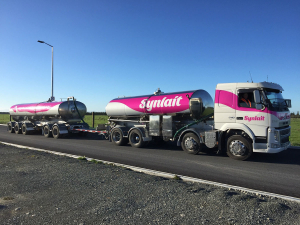
Synlait has swung to second-half profit as operations stabilise, but the dairy processor still posted a $75.4m annual loss.

LIC shareholders have elected a new North Island representative to the co-operative's Board, along with five representatives to its Shareholder Reference Group (SRG), following the company's Annual Meeting held in Invercargill.
Farmers across parts of Southland and South Otago are continuing to deal with difficult conditions after a prolonged run of wet weather, with pressure building around feed supply, stock management, pasture damage, farm infrastructure and everyday workloads.
Federated Farmers says it welcomes Labour's commitment to reviewing the Sharemilking Agreements Act, calling on other major parties to do the same.
For Canterbury dairy farmers Sian Meijer and Rick Wobben, wearable technology has become one of their most valuable on-farm tools - helping manage 1850 cows across an expansive, high-performing dairy operation while improving efficiency, mating outcomes and day-to-day decision making.
Fonterra has unveiled its annual results for the 2026 financial year, posting $27 billion in revenue and close to $20 billion returned to New Zealand farmer owners and unit holders.