UK Politician Alistair Carmichael Praises "Positive Spirit" of NZ Farmers
A leading British farming politician says he's impressed with the positive attitude of New Zealand farmers that he met during his recent trip here.
 increase font size
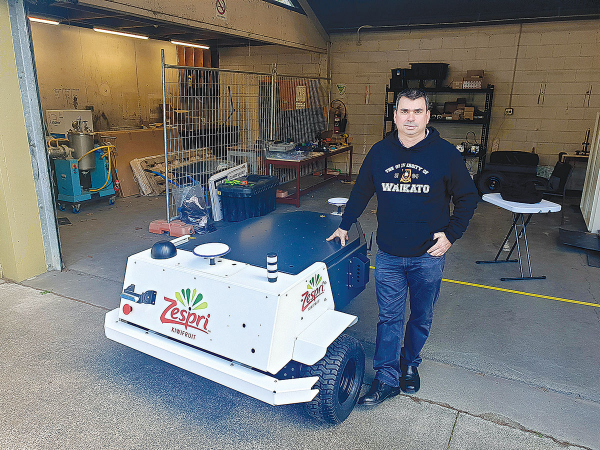 Nick Pickering with the Orchard Survey Robot funded by Zespri.
Three high-tech horticultural robots made their appearance at this year's National Fieldays at Mystery Creek.
They included a robotic asparugus harvester, an autonomous grape vine pruner and a kiwifruit orchard survey robot.
The robots are collaborative projects involving students and academics from the University of Waikato (UoW) School of Engineering and the School of Computing and the Mathematical Sciences, in partnership with other academic institutions and businesses.
"Agritech is very important to solving problems," says Dr Shen Hin Lim, senior lecturer in mechatronics and mechanical engineering at UoW and chair of NZ Robotics Automation and Sensing (NZRAS).
"New Zealand is considered a world leader in agricultural innovation, and I believe that we can demonstrate that and have an edge using ag robots," he told Hort News.
Ag robots support the horticulture sector in a number of ways, automating some time-consuming tasks, enabling people to get on with other work and offering a sustainable solution to labour shortages.
Technology also helps the agricultural industry to maintain high productivity, ensure safe, high quality food products and minimise its environmental footprint.
Lim leads the team who developed an asparagus harvester which was on display at the Innovation Hub. The fully operational prototype was developed with the support of Callaghan Innovation, in collaboration with Robotics Plus Limited.
The asparagus harvester has a high-tech vision system that detects the asparagus spears, computes their base location, and if it detects that the spear is tall enough to harvest, uses a robotic arm to cut it as the robot passes over.
Another innovative robot is the MaaraTech Grape Vine Pruner, a transdisciplinary codesign project funded by the Ministry of Business, Innovation & Employment (MBIE), including researchers from UoW, Robotics Plus, the University of Auckland, the University of Canterbury, Lincoln Agritech, University of Otago and Plant & Food Research.
Auckland University holds the contract for the five-year MaaraTech project, and UoW is subcontracted to focus on the hardware development and physical aspects of creating the technology.
Dr Benjamin McGuinness, a research and teaching fellow in mechanical engineering at UoW, says the robot’s cutting blade - dubbed “the barracuda” - has evolved over many iterations and modifications of commercial secateurs.
Its innovative design helps ensure wires are not cut by mistake.
“The design we’ve come up with has a series of slots in the anvil of the bottom blade. The idea is, the wire will fall into the slots but the cane is too big to fit in there, so the blade will cut the cane,” says McGuinness.
The Orchard Survey Robot was funded by Zespri to advance innovation and research in the kiwifruit industry, to benefit growers.
It uses a variety of sensors to autonomously navigate around the orchard to capture information that can provide actionable insights to growers, says Nick Pickering, a systems engineering lecturer at UoW, who is leading the project.
It can be programmed to capture a wide range of data through the life cycle of kiwifruit growing.
“We’ll be initiating the research later in the year starting with flower counting and canopy cover, with plans to expand the collaboration into the areas of pest and disease detection, fruit estimation and plant structure,” says Pickering.
“The information from the robot will be used to support growers to make complex decisions to optimise fruit quality and quantity.”
A leading British farming politician says he's impressed with the positive attitude of New Zealand farmers that he met during his recent trip here.

Last month's National Fieldays was an important event for Canadian manufacturer Can-Am, as it unveiled its first electric ATV, the Outlander, adding extra option to the new Defender HD11 and Defender MAX HD11 line-up.
New Zealand rural apparel brand Back Country is inviting Kiwis to part ways with tired, holey socks at Fieldays with a giant 'Sock Swap Fence' inspired by one of New Zealand's iconic rural roadside landmarks.
OPINION: The old saying 'a new broom sweeps clean' doesn't always hold up, if you ask the Hound.
More than 1200 exhibitors will showcase their products and services at next month’s National Fieldays, with sites nearly sold out.


Election years are always a concerning time for farmers, according to DairyNZ chair Tracy Brown.
The Ballance Farm Environment Awards are coming to the West Coast of the South Island.
Most dairy regions around the country have had a pretty good season so far says Tracy Brown.
Rural leader Mark Hooper has been appointed as an independent director to the NZPork board, bringing extensive farming, governance and advocacy experience to the role.
Opportunity says its land value tax (LVT) is unlikely to force farmers into a position where asset sales or increased debt are required.
Milk powder prices are keeping farmgate prices up, helping processors offset the dip in milk fat prices.