European farmers hurting too
European dairy farmers are hurting too, says Primary Industries Minister Nathan Guy.
 increase font size
 The report shows that the 51 countries reported on, plus 10 key emerging economies, paid on average US$620 billion annually to support farmers in 2015-17.
More progress is needed on reducing and redesigning the world’s farm subsidy policies, says a new report from the OECD.
It says most farm subsidy policies remain poorly aligned with defined objectives, and measures that distort production and trade keep increasing in some countries.
The OECD’s ‘Agricultural Policy Monitoring and Evaluation 2018’ report shows that the 51 countries reported on – all OECD and EU, plus 10 key emerging economies – paid on average US$620 billion annually to support farmers in 2015-17. Of this, nearly two-thirds is still provided via measures that strongly distort farm business decisions.
The report said almost 80% of the money went to individual farmers. Only 14% went to R&D or the infrastructure needed to equip farming for future challenges.
The report recommends looking hard at how to increase productivity growth sustainably and enhance environmental performance, especially given changing climates. Support should be aimed at helping farmers to better manage risks from weather, markets or other shocks that cannot always be anticipated.
 The OECD says the report underscores that most agricultural policies today are not well-aligned with these objectives.
“Progress in lowering support levels and shifting towards less distorting measures remains partial, and is not shared across all countries,” said Carmel Cahill, deputy director of the OECD trade and agricultural directorate.
“Government support of market prices harms consumers -- especially the less well-off -- and reduces the competitiveness of the food industry itself.
“Removing damaging and distorting policies is an important first step.
“Support directly linked to output and input use makes domestic and international markets work less efficiently, encourages environmentally harmful over-use of farm inputs and consumes limited public funds that could be used for more efficient investments in the sector.”
Cahill says countries should re-direct farm subsidies to ensure the availability of public services that benefit producers, consumers and society overall.
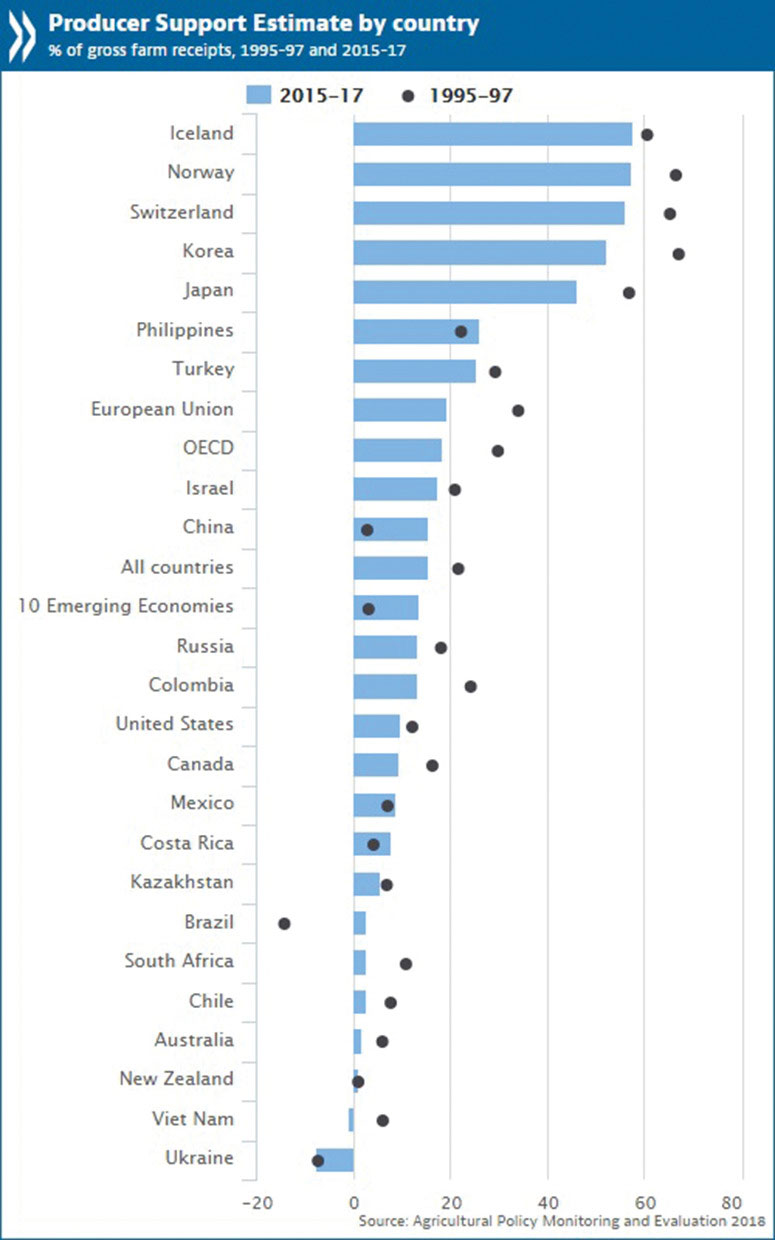
The report said the biggest subsidies are paid by Iceland, Norway, Switzerland, Korea and Japan – 40-60% of total farm earnings.
New Zealand and Australia are at the bottom of the OCED table of government support for farming.
European dairy farmers are hurting too, says Primary Industries Minister Nathan Guy.



New Zealand farmers have been told they all have amazing people on their farms and have been urged to be “that one person” that can make a huge difference to those going through tough times.

OPINION: For thousands of Southland farmers, this week would have tipped them into the non-compliant category when it comes to following regional freshwater plan rules. But the Government has stepped in to give them the clarity they deserve.
The stark realities of the world trade that New Zealand is having to face have been revealed by Trade Minister Todd McClay.
New Zealand and the European Union are closer than ever.
The latest data from the Real Estate Institute of New Zealand (REINZ) reveals a mixed rural property market due to consistent inflation concerns.
Animal welfare improvements as well as reduced costs for dairy farmers are at the heart of a new move which could help cut back on the waste of unused vet drugs.