Farm Safety Improves Through 'Incremental Gain', Says Birkett
Improving health and safety is about incremental gain rather than a sudden decision, says Leeston farmer and Federated Farmers health and safety spokesman David Birkett.
 increase font size
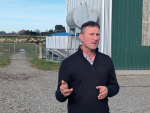
 WorkSafe NZ chief executive Gordon MacDonald.
WorkSafe NZ's chief executive says farmers should place a high priority on health and safety plans rather than doing them at the end of the working week.
Gordon MacDonald's comments come as the new Health and Safety at Work Act comes into force on April 4. He says the new act should come under the banner of 'looking after my mates' and become an important part of any business.
He adds the 'she'll be right' approach has no place in the current environment and shouldn't have had for the past 20 years under the previous act.
MacDonald says the new legislation's three key new provisions come down to the farmer's duty to manage and take responsibility for risk. Under the act, a farm is treated like any normal business, so anyone on a farm at any time is responsible for risks they may create.
"If there are contractors onfarm they can create a risk for the farmer, or the farming activity can create a risk for the farmer and the contractor or a visitor," he told Rural News.
"First, [the farmer and farm visitor] simply need to have a conversation and cooperate on how they will manage risk together.
"Second, the new legislation emphasises the importance of leadership. That says if you are the senior officer of a business – such as chief executive or a director – you need to exercise due diligence on health and safety."
MacDonald says this means having information flowing to you on what the key risks of the business are and the key controls that are in some way tracking this, to show that you are on course to deliver what the law requires and your policy objective.
Third is a provision for worker and management involvement in health and safety matters.
"This is the idea that the workers are at the sharp end and have a good feel for what the day-to-day issues are. The law says workers should be engaged and should participate in risk identification and management in the workplace."
MacDonald says the new law also requires people to think and plan for health and safety, and how it might be applied before taking any actions – "who could be harmed, the likelihood of this occurring and some sensible control and mitigation methods".
He says an example of good H&S practice would be for a farm to have a whiteboard accessible to all staff and encourage them to identify and write up risks up on this board.
However, just writing things up is not enough, MacDonald says. There must be real engagement and commitment to change by staff and managers.
"Staff views must be taken seriously and having a good H&S culture onfarm is now a priority."
A wake up call to the laggards
Farmers who already have adopted a health and safety plan will not find the new legislation difficult to comply with, Gordon MacDonald claims.
But he warns that farmers who have lagged behind in this regard will find the laws a wake-up call.
"We'll take an educative approach in the early stages of the legislation: if we can see people have their heads around those issues and are trying to make some progress on them, that's fine," MacDonald told Rural News.
However, if there is a serious risk to a farmer, worker or a visitor on April 3, then it will be a serious risk on April 4 and we'll be handling that in the same way as we usually do," he says.
MacDonald says WorkSafe has already distributed 10,000 Safer Farm Tool Kits, and DairyNZ, Beef + Lamb NZ and Federated Farmers have also informed their farmer members. The WorkSafe website is a source of information about the new law.
"All this activity points to an interest and appetite to obtain information and comply with the new law," he says. "Hopefully this will lead to improved outcomes because, as you know, agriculture sits at the top of fatality statistics, contributing over 30% of all fatalities in the workplace in NZ."
Agriculture also features high in serious harm accidents.
Improving health and safety is about incremental gain rather than a sudden decision, says Leeston farmer and Federated Farmers health and safety spokesman David Birkett.
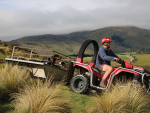
A safety push across New Zealand has revealed significant gaps in hazardous substances management, farm vehicles, tractors, quad bikes and side-by-sides.
Keeping healthy and safe during vintage 2026
Following a side-by-side rolling into a gully, Safer Farms has issued a new Safety Alert.
Farmers are welcoming new Government proposals to make farm health and safety rules more practical and grounded in real-world farming.

Esther Guy-Meakin has been announced as the new chief executive of the New Zealand Meat Board (NZMB).
According to a progress report on the Aotearoa Horticulture Action Plan (AHAP), New Zealand's horticulture sector is making real progress on the big issues facing growers.
A team effort that is paying dividends for the wider New Zealand economy.
A strong sense of community involvement is what propelled the Federated Farmers' North Canterbury president Bex Green to the honoured title of the Feds' Advocate of the Year 2026.
The country's second largest milk processor is warning against 'complacency' during a review of competition regulations in the dairy sector.
Oamaru-based livestock handling specialist Te Pari has bought Combi Clamp, the New Zealand manufacturer of Combi Clamp manual sheep handlers.