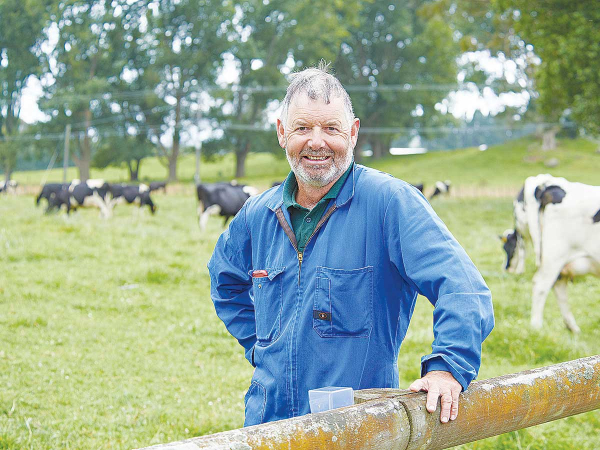
Waikato dairy farmer George Moss says New Zealand’s dairy industry must keep innovating or risk losing the mantle of being the world’s most emissions efficient.
He says it’s nice to know that NZ dairy is ahead of the pack with the lowest carbon footprint but we need to go further.
Moss was commenting on new research that shows NZ dairy farmers have the world’s lowest carbon footprint – at half the emissions of other international producers.
AgResearch analysis released last month confirmed NZ retains its outstanding position in low-emission dairy milk production, with an on-farm carbon footprint 46% less than the average of 18 countries studied.
Moss, who is also a dairy climate change ambassador, uses the America’s Cup analogy to describe the climate change battle.
“Yes, we are the holders of the cup now but if we don’t keep innovating and be smart, our competitors will take it off us,” he told Rural News.
Moss says international markets for our milk expect NZ to do the right thing when it comes to climate change.
“We also have an obligation to the NZ society to do the right thing,’ he says.
The AgResearch analysis was released just days before the Climate Change Commission consultation document was made public.
“The AgResearch report was a pleasant acknowledgment of our efficiency, the Climate Change Commission document was sobering for all NZ of the challenge ahead,’ says Moss.
Commissioned by DairyNZ, the AgResearch study was peer-reviewed by an international specialist in Ireland. The research analysed 55% of global milk production, including major milk producing countries.
New Zealand is the most efficient producer at 0.74 kg CO2e/kg FPCM (fat and protein corrected milk) – which is 46% less than the average of the countries studied. The average is 1.37kg CO2e/kg FPCM.
Moss concedes that NZ’s pasture-based farming and genetic improvements are important components.
“Grass-based farms and sophisticated animal breeding are key components to our low carbon footprint but there is more we need to do as we play our part in addressing climate change,” he says.
“We are world-leading at emissions efficient milk production, but we must continue to adapt and adopt new technology and knowledge.
“Our global competitors are never far behind, plus we know it is the right thing to do for our environment, our consumers and humanity as a whole.”