Mark Hooper Joins NZPork Board as Independent Director
Rural leader Mark Hooper has been appointed as an independent director to the NZPork board, bringing extensive farming, governance and advocacy experience to the role.
 increase font size
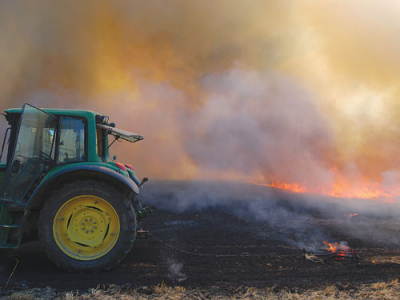 Farmers say burning off is an environmental benign way of dealing with crop residues prior to sowing the next crop.
Farmers are hoping to retain the right to burn off crop residue under the new national Fire and Emergency New Zealand (FENZ) fire authority due to be set up mid-year.
Merging urban and rural fire fighting in one organisation, FENZ has been in the pipeline since a fire services review of 2015. The Department of Internal Affairs is expected this month to release draft regulations for the new organisation, including rural fire permits.
Federated Farmers arable section vice-chair Colin Hurst says in a statement that it has lobbied to retain crop residue burning “in the face of stiff resistance”.
He says it is an environmentally benign way of dealing with crop residues prior to sowing the next crop. “It removes residue, kills insect pests or other diseases and sets the soil up for the next crop, and is an essential part of farm management”.
“Although it is done after many different crops, it is particularly valued for the removal of cereal residues prior to sowing high value and small seeded crops.”
Current regulations for permits differ across different regional fire authorities and there is “some desire” to develop a nationally consistent regime.
“Federated Farmers has talked with officials at FENZ and highlighted some of our concerns about permitting. Feds has recommended that any permitting system should be fit for purpose and balance the safety, compliance, education and land management requirements of FENZ.”
The statement follows complaints from South Canterbury arable farmer Jeremy Talbot that Mid and South Canterbury rules were inconsistent and bureaucratic.
Talbot claims that because of heavy autumn dews, a blanket ban on any burning after 1pm that remained in place after fire restrictions were eased in early March, conflicted with Clean Air Act rules that stubble must be clean and dry to reduce smoke nuisance.
Farmers trying to do the right thing by burning dry stubble were all suddenly burning off together, about 12.30pm each day. It was the worst time of day for fire risk, because if the day was heating up it would be harder to contain any fire that got away, he said.
“The common-sense way tells you to wait till the end of the day because with the katabatic effect of the wind and the sea on the east coast, with the evening-out of the temperatures between the sea and the land, the wind basically dies down. And you’re coming into the cooler period of the night with the dew to put the fire out, if there are any remaining embers.”
Talbot says the rules had cost him personally at least $5000-6000, including the purchase of a new hay bob to spread and turn the straw to try to dry it out in time. “That’s a direct extra cost to us, just because of bureaucratic stupidity.”
Talbot also criticised the bureaucracy of a fire permitting system in place in South Canterbury, instead of the code-of-practice regime in place for Mid Canterbury.
“Over the Rangitata River suddenly common sense prevails. Below the Rangitata River stupidity prevails, it would appear.”
Even in drought-hit North Canterbury there were pockets of green, but farmers could not get their fields cleaned up ready for the next crop because fires were banned under a total area policy. Talbot called for one rule which would “work everywhere”.
However, he fears that under FENZ “things are only going to get worse”.
Talbot is scathing of “townies” who reported stubble burns to the fire brigade “just to wind us up and get it banned”.
A regular business traveller to Britain, Talbot says environmental agencies in that country are beginning to realise the folly of having banned stubble burning some years ago. Pesticides such as slug bait are beginning to show up in grain above national health guidelines, and herbicide resistance is increasing.
Rural leader Mark Hooper has been appointed as an independent director to the NZPork board, bringing extensive farming, governance and advocacy experience to the role.

The terrible floods that hit the Wairarapa may have subsided, but the danger to farmers still exists, according to local Federated Farmers president Rob Hickson.
Will a stronger, more coordinated voice help rebuild confidence and improve returns in the wool sector?
New Zealand's pest problem has reached crisis point, according to Federated Farmers' second National Pests Survey, which shows farmers are spending more money and effort on control — yet pest numbers keep climbing faster than they were two years ago.
Despite political shenanigans in Wellington, farmers are confident that Resource Management Act (RMA) reforms will get over the line in this term of Parliament.



Now in its fourth year, the 2026 Fencing Industry Awards, formed part of the proceedings of the FCANZ Conference, held in Nelson during August.
DairyNZ deputy chair Cameron Henderson has been re-appointed unopposed for another term.
OPINION: The stats speak for themselves.
Farms across the upper North Island are trialling different pasture mixes as part of a research programme that aims to build greater resilience into farming systems.
Election years are always a concerning time for farmers, according to DairyNZ chair Tracy Brown.
The Ballance Farm Environment Awards are coming to the West Coast of the South Island.