Massey Uses Portable Analyser to Measure Pasture Soil GHGs
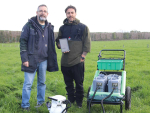
Researchers at Massey University are using a special piece of scientific equipment to improve the measurement of greenhouse gas emissions from pasture soils.
 increase font size
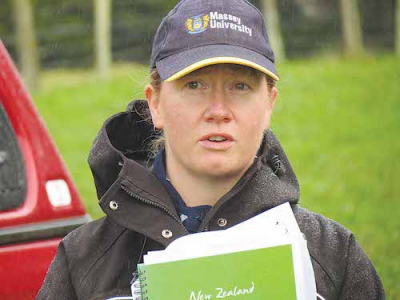 Massey University’s Dr Rene Corner-Thomas.
Shepherds may soon have a new tool to notify them of problems in their flocks.
Remote sensor technology can provide new ways for farmers to monitor their flock’s welfare, either while they sit at a computer in the office or roam on their smartphone, even remote from the farm.
Massey University scientists are working with the New Zealand Merino company to devise an electronic system to monitor ewes and lambs – especially ewes with triplets – to give farmers early warning of likely mismothering.
Currently no such commercial device is available for sheep.
Dr Rene Corner-Thomas of Massey University says they are now doing groundwork ultimately for the production of such a device.
“We have started to use activity monitors, the equivalent of a human device, to look at the behaviour of ewes and their lambs. We are particularly interested in triplets because they have a very high mortality rate, commonly around 33%, which means that one out of every litter is lost,” she told Rural News.
“We are trying to get an idea of the interaction between the ewe and her lamb and these activity monitors which have Bluetooth technology can allow us to identify whether a lamb is spending a lot of time with its mother or has become separated."
The research is intended to create a vigour measurement in the lamb.
Corner-Thomas says preliminary observations so far, while observing lamb behaviour, show that lambs more active and more demanding of their mother for feeding are more likely to survive.
“We’d like to develop a vigour index to identify lambs more at risk of dying and we may be able to create some way to intervene, for example by removing one lamb from a set and hand or artificially rearing it.”
Her summer scholarship student Rachel Shanks spent hours watching videos of triplet lambs and mothers and how they interact, with the goal of developing a scoring system. This is based on what the ewe does when the first lamb approaches her to suckle and then what happens when subsequent lambs turn up to feed.
“We are looking for the ewes that are happy to stand still and allow all three lambs to drink at the same time because potentially she is a better triplet mother,” she explains.
“We have found that often ewes seem quite comfortable with two lambs drinking, but as soon as a third one comes in it annoys the ewe and she walks away from all three lambs.
Corner-Thomas says their observations to date show different sets of behaviour with triplet lambs. In some cases they take turns to drink. But sometimes the weaker or third lamb may miss out because a ewe only wants to feed lambs for a certain time and the last one doesn’t get a feed.
The basic research being done at Massey University will ultimately help in the design of a monitoring device which Corner-Thomas hopes can be integrated in an eartag.
Researchers in the US, Europe and Australia are working on the same issue and while they have built basic monitoring devices, nothing commercial has emerged.
Corner-Thomas says the new device would work in conjunction with EID and would enable more valuable data on animals to be collected.
“Thanks to the technology, the farmer would have real-time electronic information about their sheep without having to physically see them daily,” she says.
Researchers at Massey University are using a special piece of scientific equipment to improve the measurement of greenhouse gas emissions from pasture soils.

Interest in agritech and production animal systems has prompted Massey University's School of Agriculture and the Environment to new majors to its popular animal science degree.
The industry is crying out for graduates with agricultural related degrees.
A four year trial has reaffirmed that mixing plantain into dairy pastures can help reduce nitrogen losses to freshwater while maintaining milk production and profitability, say researchers.
Special courses for secondary school teachers to help excite kids about agriculture and horticulture are now being run at Massey University.


LIC shareholders have elected a new North Island representative to the co-operative's Board, along with five representatives to its Shareholder Reference Group (SRG), following the company's Annual Meeting held in Invercargill.
Farmers across parts of Southland and South Otago are continuing to deal with difficult conditions after a prolonged run of wet weather, with pressure building around feed supply, stock management, pasture damage, farm infrastructure and everyday workloads.
Federated Farmers says it welcomes Labour's commitment to reviewing the Sharemilking Agreements Act, calling on other major parties to do the same.
For Canterbury dairy farmers Sian Meijer and Rick Wobben, wearable technology has become one of their most valuable on-farm tools - helping manage 1850 cows across an expansive, high-performing dairy operation while improving efficiency, mating outcomes and day-to-day decision making.
Fonterra has unveiled its annual results for the 2026 financial year, posting $27 billion in revenue and close to $20 billion returned to New Zealand farmer owners and unit holders.
The first major update to the Dairy Cattle Code of Welfare in more than a decade has been released, marking what DairyNZ describes as an important step in ensuring animal welfare standards continue to evolve alongside scientific evidence and on-farm realities.