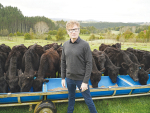
Undoubtedly the doyen of rural culture, always with a wry smile, our favourite ginger ninja, Te Radar, in conjunction with his wife Ruth Spencer, has recently released an enchanting, yet educational read centred around rural New Zealand in one hundred objects.
Divided into ten chapters, each exploring ten objects, the book is laid out to encompass a typical Kiwi farm, firstly arriving at the homestead, then the orchards, a troupe of animals and on to the farm shed. Heading out onto the farm, readers explore the cowshed, look at the creek, then wander across the backblocks taking in a wide selection of objects.
The varied range of objects will certainly be familiar with rural dwellers, often seen every day, indeed taken for granted, with little consideration of their evolution. Their stories take in the history and development, laying out the facts and dispelling local and regional folklore.
Te Radar says they have included objects that have a fundamental connection “with the rural character of New Zealand – some that have shaped us and others we have shaped out of necessity”.
“The ones we have chosen had something funny or fascinating to tell us.”
As an example, there can’t be many rural folks who haven’t sat beneath a corrugated iron veranda. The bull-nosed structures are a classic example of NZ architecture, confirmed by the fact that in 1981, more than 50% of all NZ dwellings were timber framed with corrugated iron roofs, usually with numerous dents created by people walking across them.
This leads to a wonderful story from the 1800s about an Otago waggoner called George Dungey who demonstrated his strength at Cromwell’s Victoria pub, where he flattened the pub’s corrugated wall with a punch. Of course, others have tried over the years and regretted their attempts to emulate old “Spare Me Days” George.
Recognised around the world as being a kiwi invention, the electric fence, designed to keep animals in or of course out, tells a story of Bill Gallagher trying to stop his horse Joe from relieving an irritating itch.
As horses don’t have digits to address such itches, Joe developed a technique to seek relief by rubbing himself against Bill’s Essex car. Said to be built for economy, the Essex was certainly not built to support old Joe as he rubbed back and forth.
Working on his brothers’ motorcycle, Bill had an idea to connect the machine’s magneto to the car, giving Joe a good “belt” as he rubbed himself. Joe was a fast learner and decided to find somewhere else to have a rub. Gallagher went on to develop the electric fence. This was used along the way to curtail Humphrey the elephant seal’s love affair with some dairy cows in Opoutere, create elephant corridors in Sri Lanka, keep monkeys away from homes in Saudi Arabia and protect beehives from bears in Canada.
Overall, a thoroughly enjoyable and interesting read that will be well received from a Christmas sock or stocking, delivering many hours of relaxation over the holiday. Available from any good bookshops.
Visit www.harpercollins.co.nz