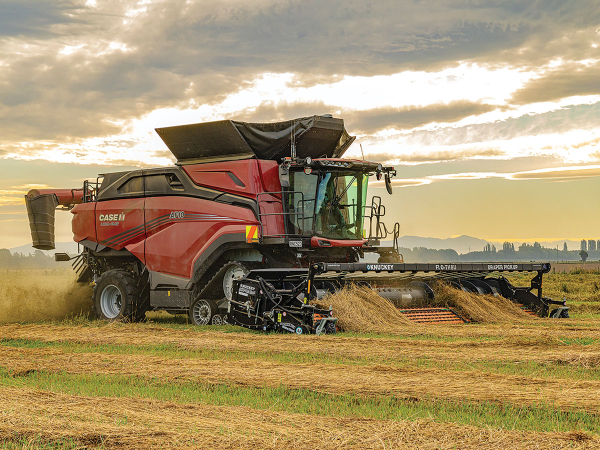
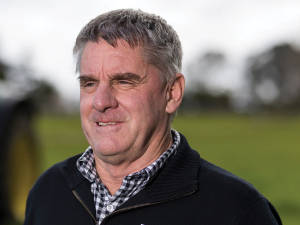
While it took some time for Wakanui farmer Eric Watson to get the tracks dirty on his new Case IH AF10 combine, he says it was worth the wait, with the challenging conditions really putting the new machine through its paces.
Watson’s 490ha farm is just east of Ashburton on the fertile Canterbury Plains. Like many other parts of the country, it was a wet summer in the region, taking a toll on the annual crop harvest.
Watson, who runs Rangitata Holdings Ltd with his wife Maxine, grew up on a mixed farming property in the area, but bought his own farm, a 490ha cropping unit just east of Ashburton, almost 35 years ago.
The move proved to be a good one, with Eric earning a global reputation for exceptional crop management after breaking the Guinness World Record for highest wheat yield, not once but twice. Achieving 17.398 tonnes/ha in 2020, he broke his own previous 2017 record of 16.791 tonnes/ha, both driven by irrigation and high-intensity management.
As well as wheat, the Watsons grow barley, ryecorn, haricot beans, grass for seed, and some vegetable seed crops such as hybrid radish and spinach.
The new Case IH AF10 replaced a Case IH Axial-Flow 9250 combine, with Eric deciding to invest in the latest harvester technology to increase harvest capacity after challenging harvests in the previous three years.
“The implication of a late harvest has repercussions for next year’s crop yields, with late sowing affecting plant development, resulting in poorer returns. The increased capacity of the AF series really makes a difference when you’re up against the clock and trying to get it done faster and more efficiently,” Eric said.
Indeed, constant rain in the region made for another challenging harvest this year, with the Watsons farm receiving 260mm from the beginning of January to the end of February, compared against their average annual rainfall of about 600mm. This resulted in delays getting into the paddocks, but when he could, the AF10, equipped with a MacDon 35ft header, impressed with its capabilities.
“With the ryecorn, which grows taller than wheat, I was surprised how well it handled the green straw, especially in the ryecorn as well as in the wheat.
“One of our ryegrass paddocks was swathed straight after about 40mm of rain, so the row was quite wet underneath when we harvested it. It never really dried in the swath, so I was surprised how well the combine handled it.”
Given the significant investment made in the AF10, Watson knew it had to justify the expense, but the amount of crop he was able to get through the combine, confirmed over snatched opportunities, shows he made the right call.
“A couple of times during harvest I was asked how much I’d got done over maybe a weekend, leaving the questioner really impressed with just how much we’d got off, and the speed with which we’d been able to do it,” he said.
775 horsepower on tap makes the AF10 Case IH’s highest horsepower and biggest capacity combine to date. The AFXL rotor of the AF10 is longer than the previous series, delivering 50% more separation output to process high-yielding crops, while the grain-handling capacity has been enhanced with an industry-leading 20,000L grain tank.
Lower Losses
Greater control and consistency during harvesting are achieved through tailored visibility in the dual Pro 1200 displays as well as real-time machine monitoring, remote view of in-cab displays and visualisation of agronomic data layers through FieldOps.
Optimisation is also evident in the Harvest Command system, monitoring the likes of ground speed, engine load, feed rate control and sieve settings, based on the data received from the loss sensors, a grain camera and sieve pressure sensors.
Eric Watson confirmed that losses during harvest were lower and the AF10 was reasonably user-friendly when it came to learning how to get the best out of the machine. He also appreciated the advantages of the new, larger Pro 1200 screen, alongside the advancement in the automation features, allowing allowed him to monitor in real time the machine’s performance and progress.
He noted that the increased rainfall and lack of sunshine during critical growing periods meant below average yields for the year, but on a positive note, the AF10 had helped his current cultivation and planting schedule.
“The AF10 has been a great investment for us, handling a variety of crops in some atrocious conditions. It performed beyond expectations, so in a year when yields were impacted, we needed every advantage we could get to maximise returns. It’s ticked every box.”