What Would Synlait Be Worth to Fonterra or a2 Milk?
Speculation of a possible joint move by Fonterra and a2 Milk to buy Synlait raises a much bigger strategic question, says agribusiness expert Dr Nic Lees.
 increase font size
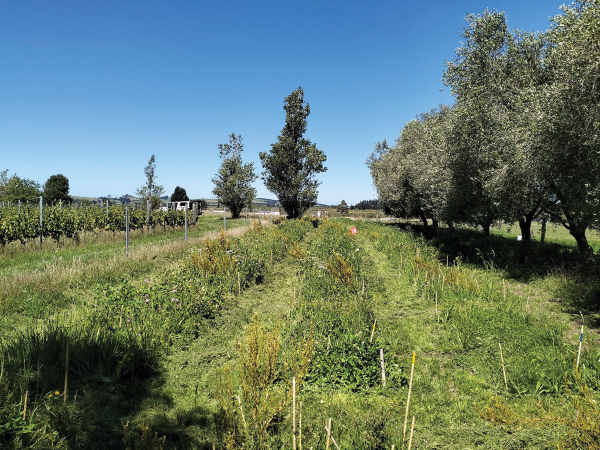 Field trial underway at Harris Estate in Waipara, with native plants and pasture growing in experimental treatment plots.
New Zealand’s wine industry produces around 100,000 tonnes of grape marc waste annually, while the forestry sector generates over five million tonnes of wood residue.
These waste streams have no established high-value end use, they are expensive to manage, but they are also rich in carbon.
Valorising these waste streams by turning them into biochar and compost for amending vineyard soils is emerging as a credible way to introduce much-needed circularity to the system.
Our research at Lincoln University is building the locally grounded evidence growers need to act on this opportunity
with confidence.
Our research team has been testing biochar and compost derived from grape marc, vineyard prunings and forestry waste on contrasting Marlborough soils to assess how they change soil characteristics.
The results are promising.
We found that overall fertility and soil carbon content were enhanced, especially in the more coarsely textured soil.
Biochar was particularly effective at enhancing aggregate stability and water holding capacity, which is likely to improve water storage, aeration, and natural nutrient cycling in the soil.
Grapevines grown in a greenhouse trial responded well to biochar amendment under both well-irrigated and water-deficit conditions: we saw significantly improved uptake of nitrogen, phosphorus and potassium (important for canopy health and berry development) across both irrigation regimes.
For growers on free-draining soils, this could translate into reduced irrigation demand, improved nutrient use efficiency and lower fertiliser costs.
Unlike compost, which cycles back into the atmosphere within seasons, biochar-bound carbon is naturally stable and can persist for decades, if not centuries.
It is looking like a genuine long-term investment in both soil health and climate mitigation.
However, growers should treat biochar as a targeted amendment. The upfront cost of using it needs to be balanced against the long term benefits it can provide.
Biochar’s strong retention capacity helps soils absorb nutrients and immobilise heavy metals, but its alkalinity can induce micronutrient deficiencies in certain soils.
Baseline soil testing is therefore essential before any amendment programme begins, and rates should be targeted to specific agronomic/ environmental objectives, soil type and existing fertility status.
One of our most recent research directions sits beyond the vine row.
Our ongoing field trial at Harris Estate in Waipara is testing the use of biochar and compost amendments to support the establishment of native New Zealand plants on vineyard margins.
Species like Tōtara, Korokio and Mingimingi carry deep cultural significance but can be difficult to establish in the low-carbon, infertile soils that are often found on vineyard margins.
The same trial is also looking at how common pasture species benefit from the amendments.
We have already seen significant improvements in soil carbon concentrations with biochar in our trial. Next, we will compare which of those species benefits most from the amendments.
If biochar’s demonstrated improvements to aggregate stability, moisture retention, and microbial activity translate into higher plant survival rates, the implications extend well beyond individual properties.
Healthy native margins contribute to pollinator habitats, riparian buffering, and carbon sequestration, while pasture species growing between rows help to reduce erosion losses.
These ecosystem services meet the demands of regenerative viticulture and are increasingly recognised by Sustainable Winegrowing New Zealand.
For an industry with a zero-waste-to-landfill target for 2050, and a consumer base that is increasingly tuning in to environmental credentials, the direction of travel is already clear.
Poorly managed piles of grape marc can be a significant amenity and compliance burden.
Converting that liability sequesters carbon, reduces fertiliser dependency, and closes a loop that currently costs the industry money.
Pine wood biochar broadens this logic beyond the winery gate, offering a complementary feedstock.
Blending biochar types, each with unique characteristics, with and without composts, can deliver a wide range of benefits.
Our ongoing research is testing different combinations to enable targeted solutions in the future.
For growers considering these amendments, replanting and new block establishment remain the most practical entry points for biochar incorporation.
Research to date has tested application rates up to 40 t/ha, but the right rate depends on soil type, pH, organic matter content, and the grower’s specific aims.
Our research has been supported by the Bioresource Processing Alliance and the Brian Mason Trust, in collaboration with Green Circle NZ, Seaview Estate, Harris Estate, the University of Canterbury and Bragato Research Institute. Long-term field validation remains the critical next step. But the current work already demonstrates that the materials are available, the science is building, and the incentives, environmental and economic, are real. Associate Professor Niklas Lehto and Dr Olaf Schelezki lead the Waste Carbon to Soil Programme in the Faculty of Agriculture and Life Sciences at Lincoln University. They work closely with Mary Dang, Phuc Nguyen, Brett Robinson, Seth Laurenson and Chamindu Deepagoda.
Speculation of a possible joint move by Fonterra and a2 Milk to buy Synlait raises a much bigger strategic question, says agribusiness expert Dr Nic Lees.

Lynnette Hudson's 30-year obsession with Pinot Noir was sparked working vintage in Burgundy, seeing how subtle changes in terroir were expressed in the glass. It was, she says, "an elightening moment in every way".
A four year trial has reaffirmed that mixing plantain into dairy pastures can help reduce nitrogen losses to freshwater while maintaining milk production and profitability, say researchers.
Twenty five secondary school students from around New Zealand recently completed a three day residential programme designed to explore career opportunities across the food and fibre production supply chain.
A Lincoln University student is set to become the first person to contest both the Young Viticulturist and the Young Winemaker national titles in one year.