From Agrichemicals to Advocate: Rex Sunde Honoured
In a classic story of poacher turned gamekeeper, Rex Sunde ditched a career in agrichemicals to help New Zealand winegrowers minimise their spray use.
 increase font size
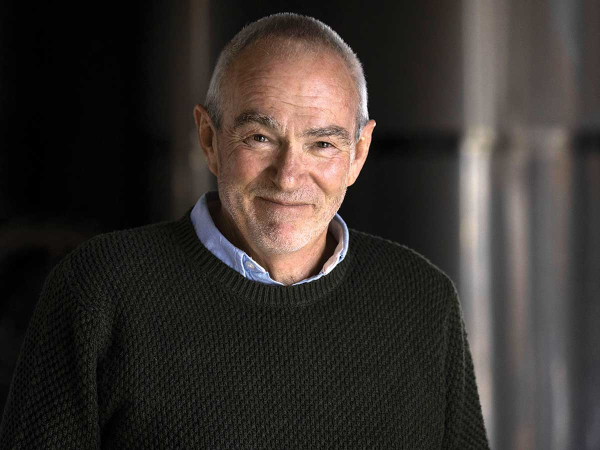 A picture tells a thousand words, they say. Kevin Judd uses far fewer. Photo Credit: Jim Tannock
Winemaking and photography each require an understanding of science, says Kevin Judd. But the final product is judged by someone else’s senses, “so they’re both an art”.
Those arts have been intertwined for Kevin since 1977, when his father suggested photography was not a good career choice, and he went to Roseworthy College instead – a beer drinker amid legacy wine students. Five decades on, the winemaker behind iconic wine companies Cloudy Bay and Greywacke has been named a 2026 New Zealand Winegrowers Fellow, recognising the impact of his winemaking and photography on the story of New Zealand wine. Kevin is typically laconic when asked what drives him in both: “I am an overthinker.”
The decision to study wine was largely about curiosity. Kevin liked science-based subjects and his father, who worked in cardboard packaging, had contacts in the wine industry. “But during the first year I wondered whether I’d made the right decision, because most of the people in the course were from winemaking families,” says Kevin, who immigrated to Australia as “a ten pound pom” when he was 9. Wine was entirely new, and there was “a little bit missing”, in his studies.
Then in the third year of the course, working with winemaker Geoff Merrill at Château Reynella, south of Adelaide, Kevin filled in the missing parts, learning to smell and taste wines, and finding the art beyond the science. The same year he met his future wife and Greywacke cofounder Kimberley, who was studying at Adelaide University. Kevin took a job at Reynella after the course, and was soon made assistant winemaker. But after Hardys took over, he saw his career prospects plummet, including threats he’d be sent to the “boondocks” to run a field crushing plant. “I thought, right, okay, I get the picture.” One morning he found his company car was gone, and decided it was a lost cause.
He had no intention of leaving Australia, and “zero” experience of New Zealand wine, but when his Kombi “blew up” on his way to an interview in the Clare Valley, he looked across the Tasman. Kevin’s main interest was white wines, and he saw potential in New Zealand’s cool climate. So on Valentine’s Day 1983, the Judds moved to Auckland for a job with Selaks, planning to return to Australia after three years. “I busted my gut and made some good wines”, including some of the gold medals the company was after, Kevin says. But they were tough economic times, and the couple were contemplating their return home when Kevin met David Hohnen in 1984, in the Sauvignon Blanc area of an Auckland wine show.
David recalled that first meeting in an interview last year, when Kevin received a Wine Marlborough Lifetime Achievement Award. David, who had won the Jimmy Watson Memorial Trophy for his Cape Mentelle Cabernet Sauvignon two years running, had recently tasted a New Zealand Sauvignon Blanc, and was set on establishing a winery here. Many of the winemakers at the show were standing around socialising, he said. “But there was one person with a notebook and a glass who was just studiously getting along and tasting and taking notes.” He is “a perfectionist in winemaking and photography”, David said. “Always looking for the extra 1% in quality.”
Kevin gave David a tour of Selaks, and suspected something was up when he fielded questions about his life. “Questions you don’t normally get asked by someone who hasn’t got something else in the back of their mind.” A few weeks later David called to offer him the job of founding winemaker at what would become Cloudy Bay.
Kevin resigned from Selaks, but stayed on for the 1985 vintage, phoning through instructions for the first Cloudy Bay Marlborough Sauvignon Blanc, made at Corbans in Gisborne, with David overseeing the Marlborough harvest. “We were after that beautiful Marlborough fruitiness, but dry and with some structure,” Kevin says. “At that point we didn’t really understand what happens to Sauvignon Blanc flavours at the final end of ripening, or what canopy management could do. They were all things we had to learn.” And are “still learning”, he says, four decades on. “The frustrating thing about it of course is we can’t go back and taste them and see them, and refresh our memory,” he says. “It’s great that wine ages and changes and has a life, but it dies. Whereas photographs don’t.”
Kimberley and Kevin moved to Marlborough in August 1985, both aged 25, as the Cloudy Bay winery was going up on Jacksons Road, leading some to speculate it was a Mormon church. The area available to purchase was limited, because David and his brother were overseas investors, and four blocks were sold on: one to Kevin and Kimberley; one to Allan Scott, whose winery still neighbours Cloudy Bay; one to Maree and Dr David Leonard, whose son Ben is now Greywacke Global Sales Manager; and one to Ivan Sutherland, who would become Cloudy Bay’s viticulturist.
For the first three years, Cloudy Bay had an agreement with Corbans, which supplied them with grapes and in return made several wines at the new winery, with Kevin’s Roseworthy peer Glenn Thomas – a fellow Pom and photographer – the Corbans winemaker. The connection also led Kevin to winemaker James Healy, who oversaw Corbans quality control in Henderson, so was there when the first Cloudy Bay Sauvignon Blanc arrived for bottling.
When Cloudy Bay needed another winemaker in 1991, “we headhunted him,” Kevin says. James, who died earlier this year, found his people and place at Cloudy Bay. Experimentation was embraced and the work was “vital and free”, he said in a 2024 profile. “It was just a perfect bunch of people together.” When Kevin won the Lifetime Achievement Award last year, James said the winemaker has “a unique clarity of thought; and that is why he’s been so successful in wine.”
Not long after he arrived, James began pushing for wild Chardonnay ferments, which Kevin considered a waste of good grapes, but agreed to, nonetheless. A year later, as a savoury and interesting Chardonnay evolved in barrel, Kevin and David became lifelong converts. Sauvignon Blanc followed suit, with the Judds offering fruit from their Greywacke vineyard. David advised them to register that name, which was carried in small print on the 1992 forerunner of Te Koko, a game-changing wine for Cloudy Bay.
They were heady days of chasing great wines, even in the worst vintages, says Kevin. In 1990, frost struck in the middle of harvest, and he returned from a birthday party in the Marlborough Sounds to find the vineyard temperature had dropped to -5C. “Within about two days the whole valley was brown.” The 1993 harvest was “off the scale” cold, while 1995 was historically wet, in a vintage wine pioneers still lament. That year they sold half their production as bulk wine. “That was the philosophy,” Kevin says. “It had to be the good stuff.” David recalled having to “broker” blending conversations each vintage to ensure enough wine was made. “We’d eventually agree on a quantity, and we never, ever, ever felt that we’d compromised.”
Meanwhile, Cloudy Bay’s reputation abroad was casting a halo over New Zealand wine. “It was a bit surreal, really,” Kevin says. “It was very rewarding to have people see what we were doing and taking it seriously. But we just kept on going. I like to think that we never believed our own back labels.” They’d occasionally go abroad and see the excitement around Cloudy Bay. “They held us on such a pedestal when it was just a bunch of blokes and blokesses.”
Along the way, Kevin became a renowned wine photographer, shooting vines, vineyards and landscapes at dawn and dusk, capturing the beauty behind the wines. In 1999, Craig Potton Publishing released Kevin’s first book, The Colour of Wine, following the seasonal cycle of Marlborough’s vineyards, while other photographs appeared in wine books, magazines and calendars around the world. In his final five years at Cloudy Bay, Kevin spent two-thirds of his time making wine and the remainder taking photographs, and in 2009, The Landscape of New Zealand Wine was released, showcasing the country’s wine regions.
The same year, the Judds launched Greywacke, amid a wine oversupply and global financial crisis. After building an extraordinary legacy at Cloudy Bay over 25 years, Kevin set about creating another, using the oversupply to access his pick of Marlborough fruit, and his global reputation to make immediate headway in tough markets. He also had support from Ivan and James, who had left Cloudy Bay to establish Dog Point Vineyard in 2002. Sixteen years on, with dedicated growers, indigenous yeasts and low-intervention winemaking, Greywacke is sold in more than 50 countries.
These days Kevin is trying to semi-retire into more photography, including plans for a trip to Iceland this year, with just a few wine meetings in London along the way. The “morph” to photographer was meant to happen sooner, he says. “I just didn’t think there was going to be this thing called Greywacke in between.”
In a classic story of poacher turned gamekeeper, Rex Sunde ditched a career in agrichemicals to help New Zealand winegrowers minimise their spray use.
For the past 35 years, Philip Gregan has helped select New Zealand Winegrowers Fellows, working with the board to choose a cohort of extraordinary industry champions.
Lynnette Hudson's 30-year obsession with Pinot Noir was sparked working vintage in Burgundy, seeing how subtle changes in terroir were expressed in the glass. It was, she says, "an elightening moment in every way".
Sir Sam Neill made an extraordinary mark on the world, and on the world of New Zealand wine.
Sauvignon Blanc New Zealand 2027 committee member Richard Ellis hopes international visitors to the event, to be held at Wairau, Marlborough from 2-4 February 2027, will leave with a deeper appreciation of New Zealand wine.


