Early Weaning Lambs: What the Massey Trials Found
Farmers with high-quality feed available in late spring could consider weaning at least a proportion of their lamb crop early to benefit both lambs and ewes.
 increase font size
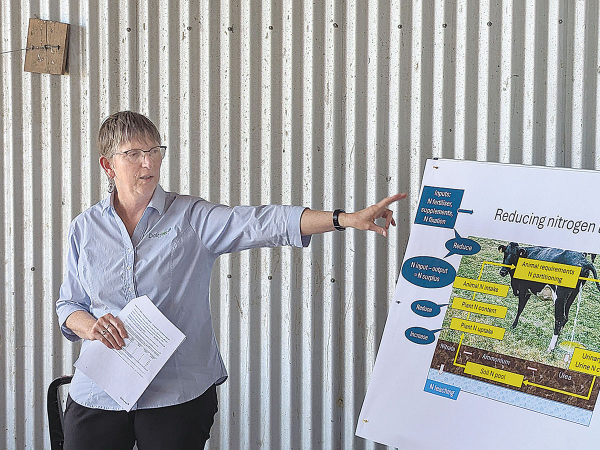 DairyNZ principal scientist Ina Pinxterhuis speaking at a recent field day in North Canterbury.
Reducing nitrogen inputs does not necessarily mean reducing profits, says DairyNZ principal scientist Ina Pinxterhuis.
Speaking at a recent North Canterbury dairy farm field day, Pinxterhuis reviewed the more than a decade of research which she had been involved with, seeking water quality improvements and contaminant mitigations.
She said the first focus of the research was reducing applied nitrogen inputs, which is now capped at 190kg/ ha/year – down from the 250-300kg/ha which was common at the time.
When she asked for a show of hands, none of the farmers attending the field day admitted to noticing lost production after the cap was imposed.
“That’s a good sign because it does mean that with a lower amount, with that nitrogen cap of 190 we have been able to maintain production,” said Pinxterhuis.
She said it was all about the four Rs: Right place, Right time, Right rate, and Right product.
Urea should be applied so that there is time for the nitrogen to become available for the plant to take it up, and also time for that nitrogen in the plant to be converted to proteins.
It was important to graze or cut at two and a half to three and a half leaves, when there was optimal use of nitrogen, exponential growth rates, and good quality.
Summarising results of a Pastoral 21 study comparing Canterbury farms between 2011 and 2015, Pinxterhuis said restricting nitrogen application did have a check on production but not on profitability.
That study compared a high input farm applying 304 kgN/ha on a stocking rate of 5.0, with a low input farm applying 156 kgN/ha on a stocking rate of 3.5.
Average production of the high input farm was 2241 kg MS/ha and average operating profit $4,205/ha. The low input farm produced only 1,700 kg MS/ha but recorded a profit of $4,300/ha.
The average N leaching was 46kg/ha and 32kg/ ha respectively.
“So the lower input system was more profitable than the higher input system.
“But we managed to reduce nitrate leaching by 30 percent and that was what we set out to do. Our models were showing that and the measurements showed it as well.”
Pinxterhuis said more recent research by Lincoln University’s Racheal Bryant looked at different ways of applying the 190kg, whether a few larger applications or many smaller applications, and compared those regimes with pasture receiving no fertiliser.
Pinxterhuis said there was significant response to all N treatments, but the “interesting” finding was that after January, there was no difference in yields in the pastures that continued to be fertilised compared to the pasture that wasn’t.
The message was that farmers should focus on spring fertilising and production and to utilise that production, perhaps as silage.
There would be some benefit of nitrogen applied later in the season in a new paddock still building up after renewal, but in a well-established pasture with adequate clover, the clover provides the nitrogen.
“Later in the season, just the natural processes can take over.”
 |
|---|
|
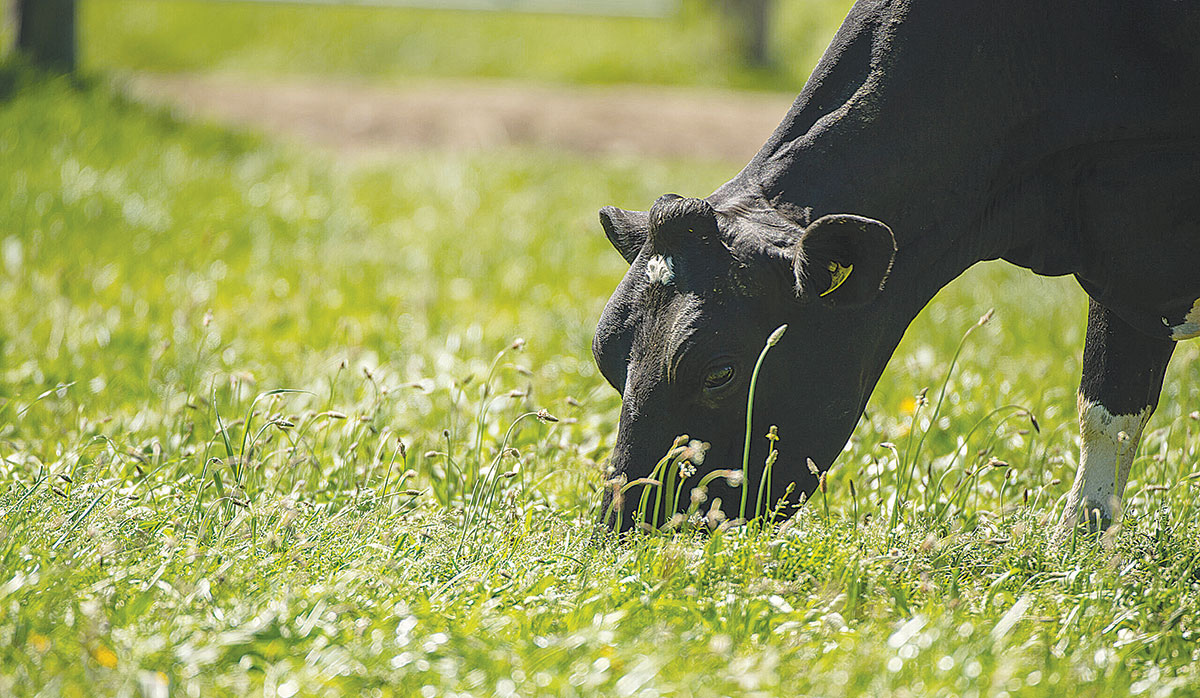
Restricting nitrogen application did have a check on milk production but not on profitability. |
Asked how much clover should be in pasture, Pinxterhuis said it was “a bit circular” because clover doesn’t get the chance to grow if you keep applying nitrogen. However, in that trial and others, clover was only about 10% of dry matter on average. Clover might be barely visible in spring but make up to 20 to 30% in summer, when it is flowering and easily seen, she said.
Pinxterhuis also outlined the research around plantain as a nitrogen reducer, citing a current study comparing nitrate leaching from a pasture of just perennial ryegrass and white clover, and another with 15-30% plantain.
She acknowledged that like many farmers they were struggling to maintain the plantain percentage but were still recording worthwhile N leaching reductions.
“In the graph you see what the plantain content was that we achieved – 24% in the first year, 17 in the second 12 in the third.
“But you can see also that the total nitrogen leaching was actually a lot lower still on the plantain – on average, 23% in the first two years.
“In the third year, we don’t have all the data yet but the data up till August is in the graph and it’s still showing a significant reduction.”
Farmers with high-quality feed available in late spring could consider weaning at least a proportion of their lamb crop early to benefit both lambs and ewes.
Today, 15 October, is the International Day of Rural Women, which recognises rural women’s contribution to farming, communities and the environment.
The first major update to the Dairy Cattle Code of Welfare in more than a decade has been released, marking what DairyNZ describes as an important step in ensuring animal welfare standards continue to evolve alongside scientific evidence and on-farm realities.
Have a plan in place for your cows and staff.
Bovine Viral Diarrhoea (BVD) is sometimes viewed as a dairy industry issue, but the reality is that the disease can have serious consequences for beef breeding herds as well.


Federated Farmers has welcomed new rural policies released by ACT, saying they align closely with its own election priorities.

Rural Contractors NZ says proposed changes to land transport rules for agricultural vehicles are a welcome response by the Government to out of date regulations which have seen members hit with huge fines.
Alliance is calling for final applications for its 2027 Graduate Programme, with applications closing on Sunday 25 October.
Decades piloting planes has ensured vet and farmer David Hayes is focused on safety. So, after a serious accident while welding on farm, he is sharing his experience so others can learn from it.
Canterbury milk processor, Synlait Milk has confirmed Leon Fung as its chief executive officer.
OPINION: Making it easier to collect rainwater and use it to grow crops and livestock is a no brainer.