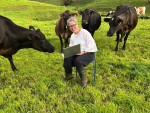
International Day of Rural Women: Two DairyNZ Farmers’ Stories
Today, 15 October, is the International Day of Rural Women, which recognises rural women’s contribution to farming, communities and the environment.
 increase font size
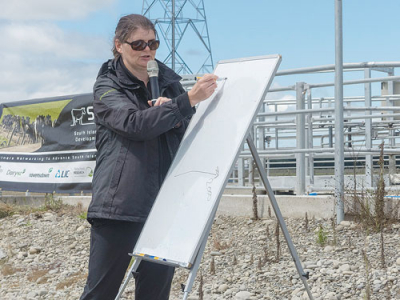 Jane Lacy-Hulbert, DairyNZ.
It is time to move away from whole-herd antibiotics to protect stock against mastitis at drying-off, says DairyNZ senior scientist Jane Lacy-Hulbert.
Instead she is advocating internal teat sealant for low-risk cows, while reserving antibiotics for cows identified as infected, such as by somatic cell count.
The New Zealand Veterinary Association has adopted an “aspirational goal” that by 2020, antibiotic dry cow therapy will only be used in the treatment of existing intramammary infections.
Lacy-Hulbert estimated about 70% of farmers are now treating every cow with antibiotics, while the other 30% are taking a more selective, targeted approach using other treatments to protect uninfected cows.
“We’ve got to reverse that over the next few years,” she said.
Lacy-Hulbert said changes are needed due to rising concerns in human medicine at antibiotic resistance, hence doctors are prescribing fewer antibiotics.
“The medics are getting it, beginning to change how they’re doing things. In agriculture we are going to need to... use our products, the antibiotic products, wisely.”
Lacy-Hulbert said herds used to have far higher somatic cell counts, and antibiotic dry cow therapy was commonplace under the five-point plan.
Now there is a much lower level of mastitis in cows going into the dry period. The need to treat cows for pre-existing infections has dropped and blanket DCT is no longer seen as a wise use of antibiotics. The dairy industry world-wide is pulling back.
Speaking at the recent Lincoln University Dairy Farm Autumn Focus Day, Lacy-Hulbert said a study last winter of 36 herds (19 in Waikato, seven in Canterbury, six in Oamaru and four in Southland) tested both the process used to select cows for antibiotic treatment at dry-off, and the efficacy of using teat sealant alone on the others.
She said the study found levels of bacteria a lot lower than expected: 30% of cows had “something” in the udder but only 7% had what would be classed as major pathogens.
That meant there was “a lot of space for us to look at reducing dry cow therapy,” she said.
The study found that somatic cell count was the best way to identify cows with major pathogens.
The last herd test was as predictive of infection status as multiple herd tests, and a herd test in the last 80 days of lactation was equally predictive.
Meanwhile, of the cows receiving teat sealant alone, only 1% went on to develop clinical mastitis.
Further research would aim to find the “sweet spot” for the SCC threshold.
A raised threshold would leave a few more infected cows missing DCT, Lacy-Hulbert said.
“But at the same time we also want to move away from treating everything with antibiotics. There’s a tradeoff between the risk of missing the odd infected cow that could’ve done with some dry cow therapy, versus reducing our overall use of dry cow antibiotics.”
“What we find is that the outcomes for cows that miss the dry cow therapy are OK; they don’t get worse if they get a teat sealant and they often cure themselves.”
Research is underway to test internal teat sealant in different scenarios, to give farmers and veterinarians more confidence to rely on it, she said.
Today, 15 October, is the International Day of Rural Women, which recognises rural women’s contribution to farming, communities and the environment.
The first major update to the Dairy Cattle Code of Welfare in more than a decade has been released, marking what DairyNZ describes as an important step in ensuring animal welfare standards continue to evolve alongside scientific evidence and on-farm realities.
Have a plan in place for your cows and staff.
DairyNZ deputy chair Cameron Henderson has been re-appointed unopposed for another term.
OPINION: The stats speak for themselves.


Federated Farmers has welcomed new rural policies released by ACT, saying they align closely with its own election priorities.

Rural Contractors NZ says proposed changes to land transport rules for agricultural vehicles are a welcome response by the Government to out of date regulations which have seen members hit with huge fines.
Alliance is calling for final applications for its 2027 Graduate Programme, with applications closing on Sunday 25 October.
Decades piloting planes has ensured vet and farmer David Hayes is focused on safety. So, after a serious accident while welding on farm, he is sharing his experience so others can learn from it.
Canterbury milk processor, Synlait Milk has confirmed Leon Fung as its chief executive officer.
OPINION: Making it easier to collect rainwater and use it to grow crops and livestock is a no brainer.