Pāmu FY26 Report: Profit More Than Doubles to $113m
Pāmu has released its FY26 Integrated Annual Report, reporting a Net Operating Profit of $113 million, more than double the $49 million recorded in FY25.
 increase font size
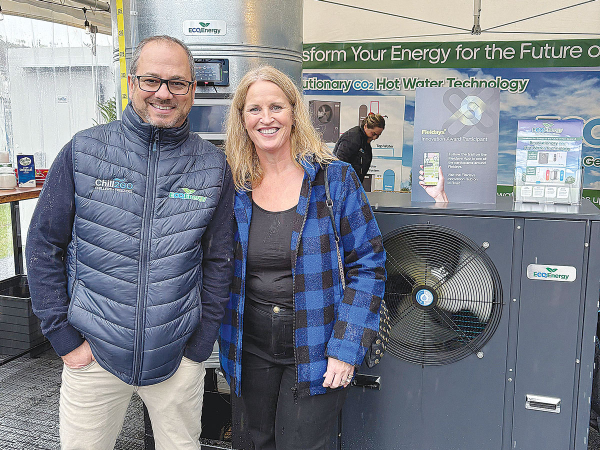 Eco2Energy founder Nick Papa with Cabinet Minister Louise Upston at Mystery Creek Fieldays.
A Taupo company says it's the first to bring CO₂-powered water heating technology to New Zealand dairy sheds, helping farmers cut energy costs by up to 85%.
“We saw a real opportunity to help dairy farmers manage rising power costs while protecting milk quality and meeting sustainability goals,” says Nick Papa, co-founder of Eco2Energy.
“Our system uses a natural CO₂ refrigerant to produce hot water up to 90°C, while significantly cutting energy use. It’s proven technology overseas, and we’ve adapted it to suit the needs of Kiwi dairy farms.”
CO₂ water heating is already widely used in Europe and Japan for food processing and commercial applications, but Eco2Energy is the first to introduce it to New Zealand’s dairy sector.
“Most farms can expect a payback time of around 2.5 years, depending on their current energy use and system setup,” says Papa.
“The Government’s new Investment Boost tax incentive could also help farmers invest in technology like this.”
Unlike traditional electric systems, Eco2Energy’s CO₂ technology gets more heat from less power, delivering up to 3.9kW of heat using just 1kW of electricity.
It runs on natural CO₂ refrigerant, which is not only clean and efficient but also better for the environment.
The system works in a closed loop, where the CO₂ refrigerant recycles energy as it goes. This means no waste, no emissions, and consistently strong performance.
With calving underway and new season milk flowing, hot water might not be front of mind, but it plays a big role in milk quality and compliance.
“It’s one of those things that doesn’t always get attention until there’s an issue,” says Mike Donovan, head of business development. “But when it comes to cleaning and hygiene, consistent hot water is essential.”
Donovan spent 26 years dairy farming and 18 years with Ecolab helping farmers improve milk quality through better hygiene systems. He knows just how critical reliable hot water is to maintaining milk quality.
“If your plant or silo wash doesn’t reach the right temperature, you risk leaving behind residues or bacteria that can compromise the next milking. That can lead to costly milk quality downgrades.”
“Getting it right helps protect milk quality, keeps things running smoothly, and takes one more pressure off during a busy time like calving.”
Positive Feedback
There was strong interest in Eco2Energy’s system at this year’s Mystery Creek Fieldays. Many farmers were surprised by how much of their power bill goes into heating water and many hadn’t come across CO₂ technology before.
Eco2Energy’s technology is now being used on farms across the South Waikato and Central Plateau, with promising results. Farmers are getting consistent 85–90°C hot water when they need it, even during peak times like morning milking.
Early feedback shows improved wash performance and noticeable energy savings compared to traditional setups.
Pāmu has released its FY26 Integrated Annual Report, reporting a Net Operating Profit of $113 million, more than double the $49 million recorded in FY25.

Environment Minister Nicola Grigg has announced details of a new rural plastics recycling scheme.
Almond hulls sourced from Australian orchards may have the potential to help New Zealand cows reduce emissions, boost milk yield and lower input costs.
The Government is introducing a new nationwide rural recycling scheme that will significantly increase the recovery of farm plastics from March next year, Minister for the Environment Nicola Grigg announced today.
Climate, nature and animal wellbeing make up Fonterra's refreshed sustainability roadmap released last week.



When Northland leather worker Vernon Suckling started making horse saddles 50 years ago, quad bikes and side-by-side vehicles were unheard of.
Alliance Group has confirmed that eligible farmer-shareholders who supply and continue to back the business will receive up to $20 million later this year, following the strategic investment partnership with Dawn Meats.
With a general election under five weeks away, Rural News is asking major political parties about their policies and positions on key issues facing the primary sector. We will run their responses to each question over the next four weeks. The ACT Party and the Greens didn't respond in time.
The red meat sector is in great heart.
Dr Scott Champion, Foundation for Arable Research chief executive, says that everyone in the supply chain had a role to play in driving the sector's long-term success.
Entries opened on Monday, 5 October 2026 for the 2027 New Zealand Dairy Industry Awards (NZDIA), which organisers describe as the nation's biggest celebration of excellence in the dairy sector.