Fonterra FY26 Results: $9.69 Milk Price, $3.4bn Profit
Fonterra has unveiled its annual results for the 2026 financial year, posting $27 billion in revenue and close to $20 billion returned to New Zealand farmer owners and unit holders.




 increase font size
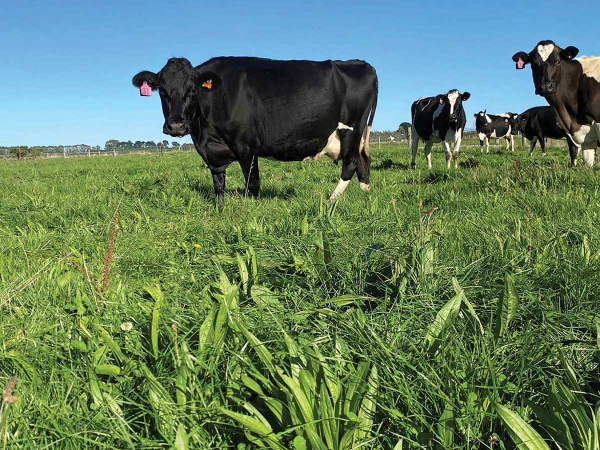 The trial showed nitrate leaching was reduced in pastures containing plantain dry matter.
A four year trial has reaffirmed that mixing plantain into dairy pastures can help reduce nitrogen losses to freshwater while maintaining milk production and profitability, say researchers.
Final results from the farmlet trial at Lincoln University Research Dairy Farm showed annual nitrate leaching was reduced by an average of 33% from 18 kg/ha/year to 12 kg/ha/year in perennial ryegrass-white clover pastures containing an average of 17% plantain dry matter, compared with pastures without plantain.
The Lincoln trial, part of DairyNZ's Plantain Potency and Practice programme, compared nitrogen leaching and production between farmlets with perennial ryegrass and white clover pastures sown with, or without, Ecotain plantain.
The findings support those reported from the programme's grazing trial at Massey University, several smaller component studies, and the aligned Low N Farmlet Trial, also at Lincoln University, that stacks plantain with other nitrogen mitigation options.
DairyNZ senior project manager Kate Fransen says milk production remained consistent across both treatments. Herbage production and silage use were also similar between treatments.
"The findings demonstrate that plantain can deliver environmental benefits without compromising farm performance," says Fransen.
Fransen says the nitrate leaching reductions achieved at Lincoln are more than double those predicted by current models which only account for the effect of plantain on reducing urinary nitrogen.
"The high-water content of plantain dilutes the concentration of cow urine, and the nutritional makeup of plantain also causes more nitrogen to be diverted to faeces and milk, and less into urine.
"We are now gaining a better understanding of the effects of plantain on drainage and nitrogen cycling in soil which result in additional reductions in nitrogen leaching.”
The programme aims to have these additional effects of plantain reflected in models such as Overseer by 2028.
One of the key findings was that relatively low levels of plantain still delivered good reductions in nitrogen losses.
“At the Lincoln site, we achieved consistent reductions in nitrate leaching over four years, despite plantain content plateauing to 10-15% in the final years of the trial,” says Fransen.
The programme has also worked with more than 30 partner farmers in N-sensitive catchments. This has provided practical insights on using plantain, and supported understanding of the wider farm systems implications and potential catchment-scale impacts through benchmarking and modelling.
Plantain is a short-lived perennial and mixed swards require ongoing maintenance through oversowing or undersowing.
Partner farmers have successfully maintained 10–15% plantain content by including Ecotain in new pasture mixes and broadcasting seed annually, at an estimated cost of $46/ha per year.
DairyNZ modelling indicates that achieving similar reductions in nitrogen leaching without plantain would likely require substantial reductions in nitrogen fertiliser use, imported feed and stocking rates, or significant infrastructure investment, with greater impacts on farm profitability.
The benefits of plantain for reducing nitrogen leaching are recognised in regulatory frameworks in Canterbury, Southland, Waikato, Bay of Plenty and Horizons.
Ecotain plantain has been used in all programme trials where leaching has been measured and is proven to be effective at farm scale.
The Plantain Potency and Practice programme is a collaborative research initiative that commenced in 2021 led by DairyNZ and funded by the Ministry for Primary Industries through the Sustainable Food and Fibre Futures fund (now Primary Sector Growth Fund), DairyNZ, PGG Wrightson Seeds and Fonterra.
Research is delivered in partnership with Lincoln University, Massey University, Lincoln Agritech and the Bioeconomy Science Institute.
Fonterra has unveiled its annual results for the 2026 financial year, posting $27 billion in revenue and close to $20 billion returned to New Zealand farmer owners and unit holders.
The first major update to the Dairy Cattle Code of Welfare in more than a decade has been released, marking what DairyNZ describes as an important step in ensuring animal welfare standards continue to evolve alongside scientific evidence and on-farm realities.
Fonterra Co-operative Group has confirmed the independently assessed candidates standing for election to its board in 2026.
Fonterra has revised its Farmgate Milk Price forecast for the 2026/27 season, lifting the midpoint and narrowing the range on the back of improving global dairy commodity prices.
Outgoing Fonterra Co-operative Council chair John Stevenson says that it has been a privilege to represent the co-op's farmer shareholders.



LIC shareholders have elected a new North Island representative to the co-operative's Board, along with five representatives to its Shareholder Reference Group (SRG), following the company's Annual Meeting held in Invercargill.
Farmers across parts of Southland and South Otago are continuing to deal with difficult conditions after a prolonged run of wet weather, with pressure building around feed supply, stock management, pasture damage, farm infrastructure and everyday workloads.
Federated Farmers says it welcomes Labour's commitment to reviewing the Sharemilking Agreements Act, calling on other major parties to do the same.
For Canterbury dairy farmers Sian Meijer and Rick Wobben, wearable technology has become one of their most valuable on-farm tools - helping manage 1850 cows across an expansive, high-performing dairy operation while improving efficiency, mating outcomes and day-to-day decision making.
Fonterra has unveiled its annual results for the 2026 financial year, posting $27 billion in revenue and close to $20 billion returned to New Zealand farmer owners and unit holders.
The first major update to the Dairy Cattle Code of Welfare in more than a decade has been released, marking what DairyNZ describes as an important step in ensuring animal welfare standards continue to evolve alongside scientific evidence and on-farm realities.




OPINION: It seems Canterbury processor Synlait is still in the doldrums.
OPINION: Get offside with New Zealand First leader Winston Peters at your own peril.




