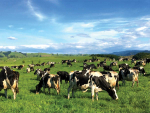
DairyNZ's Tracy Brown Flags El Nino Risk for Dairy Farms
Most dairy regions around the country have had a pretty good season so far says Tracy Brown.
 increase font size
 Con Williams
Milk prices were down again in international markets last week but the New Zealand dollar’s drop means prices are up in our money.
The fall on GlobalDairyTrade (GDT) was the smallest since values started sliding again in March with the overall index down 1.3% and whole milk powder (WMP) back just 0.1%.
The average price across all commodities was US$2409/t with WMP at US$2327/t, still 4% above its December nadir of US$2229/t. Drought fears induced a rally to US$3272/t in February but it’s been downhill ever since.
“It was another weak one: we’re sort of getting used to it,” commented BNZ senior economist Doug Steel after last week’s auction.
However, since the previous auction, on June 2, the NZ$ had fallen about twice as much as the 1.3% fall in GDT hence prices in local terms are up about as much as they were down in US$, he added.
“But we really need higher international prices to achieve our forecast and Fonterra’s milk price forecast before the season is done,” he warned.
BNZ’s current prediction is for a NZ$5.70/kgMS payout for 2015-16, compared to Fonterra’s $5.25/kgMS milk price forecast. Given the volatility in the market there’s not really a lot of difference in those forecasts, he says.
“It’s almost within the margin of error.... The question is when will prices recover and will it be far enough to get the payout into the $5’s?”
If current prices and exchange rates persist, the payout would be “even lower than 2014-15’s $4.40,” he added, but such a scenario would almost certainly see the Kiwi fall “further and faster”, supporting prices in NZ$ terms.
While Steel didn’t mention it, weaker currency would likely mean prices of imported inputs such as fuel, fertiliser and PKE would rise but the gains in domestic milk prices should outweigh that downside.
Steel says the continued weakness in dairy markets is due to questions over stocks in China and strong domestic production in that market. “Demand from China is still not as strong as people thought it would be and therefore [China’s] impact on the market’s not as strong.”
Russia’s continued trade ban with the US and EU is another key factor. “Last year when they announced it [in August] they said it would be for one year. Now the debate is whether they will lift the ban.”
Meanwhile EU and US supply growth, while slowing, isn’t responding to low milk prices as fast as it might because markets for feed grains are extremely weak.
The response to the end of quotas in the EU in April also still remains to be seen.
“It’s not so much a question of whether Ireland and the other efficient producers are growing, as how do the less efficient nations respond. Will their governments support them or let the war of attrition begin?”
ANZ’s Con Williams also noted the NZ dollar’s positive influence on domestic milk values but flagged a concerningly flat WMP price spread.
“Across the last two auctions there’s been a bit of softening in those fourth quarter prices, particularly for milk powder. That suggests China’s import demand is not about to erupt anytime soon which is a concern for prices in 2015-16.”
ANZ’s forecast for the season is still $5-5.25/kgMS but if current prices and exchange rates remained it would be $4.20/kgMS, he notes. “We still see the gain as achievable.”
Weaker currency plays “quite a part” in that view, as does a potential drop in New Zealand’s production due to lower cow numbers following high cull rates and fewer conversions. Weather, notably El Nino, could also have an impact.
However, Williams doesn’t believe Russia will reopen its borders to EU and US product, so increased competition in other markets will remain. “The drive in Russia is towards self-sufficiency. That’s quite a structural change in the market.”
Most dairy regions around the country have had a pretty good season so far says Tracy Brown.
Fonterra says its interim results show continued momentum in its performance, with revenue of $13.9 billion in the first half of the 2026 financial year.
The red meat sector finds itself in "a very rare set of circumstances", says Federated Farmers meat and wool industry chair Richard Dawkins.
A solid recovery of global dairy prices this year makes a $9.50/kgMS milk price almost a shoo-in for this season.
Fonterra has slashed another 50c off its milk price forecast as global milk flows shows no sign of easing.



Seed and grain companies share the concerns of arable farmers about the viability of their sector, says Seed and Grain New Zealand chief executive Dr Sarah Clark.
The New Zealand Institute of Forestry (NZIF) says unnecessary changes to New Zealand’s Emissions Trading Scheme (NZ ETS) will seriously erode investor confidence and result in significant reductions in forest planting rates.
For the first time in a quarter of a century, Federated Farmers has something positive to say about the Labour Party’s climate change policy leading into a general election.
A warning for New Zealand seed and grain companies – be prepared for an exodus of farmers from the arable sector.
Now in its fourth year, the 2026 Fencing Industry Awards, formed part of the proceedings of the FCANZ Conference, held in Nelson during August.
DairyNZ deputy chair Cameron Henderson has been re-appointed unopposed for another term.