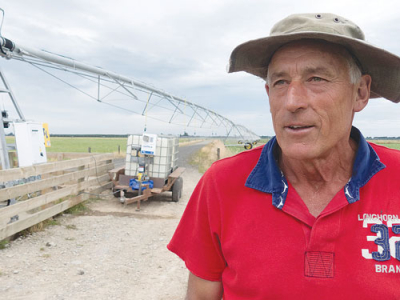
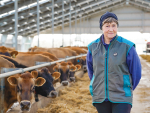
Darfield farmer Peter Abrahamson was a fan of fertigation (fertilisation of crops and pasture by liquids fed through irrigation systems) even before he could irrigate.
He is now in his first season irrigating, on Stage Two of the Central Plains Water scheme, and is in the process of commissioning his fertigation system. He runs a dairy support farm, with 70ha in kale and 95ha in pasture for grazing heifers.
He began researching fertigation some years ago, and the clincher for him was seeing kale grow to 0.5m high, making it impractical to fertilise by vehicle.
Fertigation is the new buzzword in the irrigation industry. IrrigationNZ has just released a guide to its adoption, saying its use is increasing overseas as farmers see it as good environmental practice. It enables irrigators to apply liquid or water-soluble fertiliser little and often, at the same time as water, and should reduce nitrogen leaching and save labour onfarm.
“IrrigationNZ in September 2018 ran a study tour to Nebraska, US,” says Andrew Curtis, IrrigationNZ’s retiring chief executive. “Twenty-five members joined the tour including farmers, irrigation designers, environmental consultants and irrigation scheme representatives.
“Farmers in the state were encouraged by authorities to use fertigation as a tool to help reduce fertiliser use and nitrogen leaching and to save costs by reducing the labour involved in applying fertiliser. Our tour group were excited about the opportunities to adopt fertigation here.
“The new guide is being launched to provide farmers and those working in the irrigation sector with advice on how to correctly use fertigation.”
Abrahamson said it is not like the “dump and run” of applying dry fertiliser by truck then worrying whether you will get the right amount of rain to water it in. “It’s the future of farming; I can see it.”
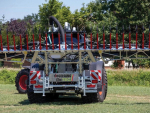
He intends to apply AgriSea seaweed liquid and liquid urea from a trailer carrying a US-made Agri-Inject electric injection pump and computerised controller, with a couple of small tanks to carry the liquid fertiliser from the farm’s storage tank.
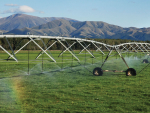
The trailer can be plugged into his three pivots as needed. The pivots were built from the start to accommodate the system, with a special valve body at the base.
He says some farmers wanting to retro-fit fertigation may find they are limited by insufficient electrical supply at their pivots.
Pāmu Farms (formerly Landcorp) is working with IrrigationNZ to trial fertigation over two irrigation seasons on its Canterbury dairy farms.
Pāmu’s general manager of innovation, environment and technology, Rob Ford, says, “By injecting soluble fertiliser through the pivot irrigation systems little and often we are maintaining farm profitability, productivity and growth of high feed value pasture.
“Pāmu is using this innovation to reduce its environmental footprint.”
Ballance Agri-Nutrients is a partner in the planned Pamu trial, and it has a grant from the Sustainable Farming Fund.
Said Andrew Curtis, “A few irrigators are already using fertigation successfully in NZ. If the trial shows fertigation to be a better environmental practice and practical to implement on farms we would like to see it more widely adopted.”
Fertigation can also be used to apply seaweed and selenium to crops and pasture.
Andrew Paterson, Matakanui Station, Otago is another early adopter of fertigation on his sheep and beef farm. He says applying fertiliser via pivots is more convenient and efficient than using trucks.