Ballance Farm Environment Awards Launch on West Coast
The Ballance Farm Environment Awards are coming to the West Coast of the South Island.
 increase font size
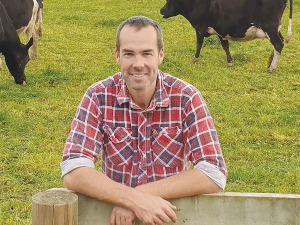
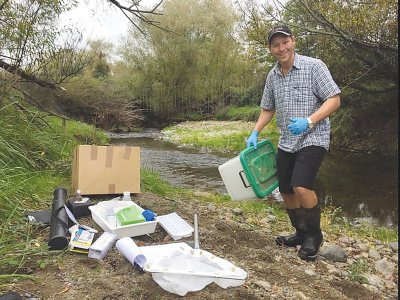 Robert Barry monitors his local stream using water testing kits funded by Fonterra.
Rodents are copping it on an 8ha bush block on a farm owned by BEL Group near Waipukurau, central Hawke’s Bay.
This area is known to attract ferrets, stoats, weasels, rats, mice and occasionally possums, which prey on the birds and their eggs.
The block, under a Queen Elizabeth II Trust covenant, has about a dozen traps and “an extensive trapping programme,” says Robert Barry (27), the head of environmental work for BEL Group.
He uses traps made by NZ Autotraps. The traps reset and re-bait themselves, improving the kill rate.
“The great thing about these traps is that they aren’t labour intensive and they kill a range of predator species,” says Barry, a Tikokino Young Farmers member.
Barry’s passion for the environment has won him several accolades and landed him the job. He and his wife Alison were finalists in the 2018 Ballance Farm Environment Awards for East Coast, winning the Predator Free 2050 and DairyNZ Sustainable Farming Award.
BEL Group was started by Barry’s mother Andrea and his late father Peter in the 1990s. It now employs 70 fulltime staff.
The business milks about 9000 cows on nine dairy farms. It owns or leases eight dairy support blocks.
Before his new job, Barry was second-in-charge on one of the dairy farms.
“This job is a great fit for me,” he says. “I’m passionate about improving dairying’s environmental footprint. I was always suggesting ways to improve our practices.”
Quitting the daily milking routine has enabled Barry to start implementing his ideas. The business overhauled its wintering practices this year, aiming to cut nitrate and sediment loss from crop paddocks.
“It’s something everyone can do,” he said. “Being smart about where you plant winter crops and how you feed them can lead to a big reduction in sediment runoff.
“It can often be as simple as putting up a back fence or using a portable water trough to help reduce soil damage.”
Grazing sections of crop growing near waterways or at the bottom of slopes last helps trap suspended contaminants.
About 50 employees feed out to cows and young stock over the winter and shift crop fences.
Two fulltime fencers work at fencing off small drains.
“Legally we don’t need to fence them off. But they’re areas that get wet and boggy in winter, and reducing the number of cows walking through them can help the water quality.”
Most of the farms lie in the Tukipo River catchment which has poor water quality.
“The river doesn’t have the benefit of a large volume of fresh water flowing through it,” Barry said. “It’s fed by springs on surrounding farmland. Keeping livestock out of those springs makes a difference.”
Students from the local school are helping to grow native plants and trees for the newly protected areas.
BEL Group gave $4000 to help the school extend its shade house which can now produce 1000 riparian plants a year.
Barry chairs the Tukipo Catchment Care Group he founded in February 2018.
The farmer-led group aims to improve water quality, biodiversity and their greenhouse gas footprint.
“This year through the group I have applied for and received $32,000 from Fonterra to buy water testing kits and to find potential wetland sites,” he said.
Governance experience
Robert Barrry was recently elected to the NZ Young Farmers board.
“I thought about standing for the board for two years,” he said. “To be elected and have the backing and support of my fellow members is awesome.”
Nine people sought two positions in a hotly contested election. Barry saw joining the NZ Young Farmers board as a way to get governance experience.
“Not many boards set the criterion of being under 31 years of age, so it was an opportunity I had to seize,” he said.
Barry will be on the NZ Young Farmers board for two years.
The Ballance Farm Environment Awards are coming to the West Coast of the South Island.
There's been widespread support from the primary sector for the Government's announcement on changes to freshwater farm plans that come under the Natural Environment Bill, which is now set to replace the existing RMA.
The chair of the country's environmental regulator, the Environmental Protection Authority (EPA), says changes are already under way to improve the performance of the agency to better meet the needs of those who interface with them.
New Zealand's Emissions Trading Scheme (NZ ETS) encourages afforestation while not achieving climate goals, says a new report released by the Parliamentary Commissioner for the Environment, Simon Upton.
Retiring MP and dairy farmer Mark Cameron is blasting the Green Party for proposing to ban the use of synthetic fertiliser and cutting cow numbers.



Now in its fourth year, the 2026 Fencing Industry Awards, formed part of the proceedings of the FCANZ Conference, held in Nelson during August.
DairyNZ deputy chair Cameron Henderson has been re-appointed unopposed for another term.
OPINION: The stats speak for themselves.
Farms across the upper North Island are trialling different pasture mixes as part of a research programme that aims to build greater resilience into farming systems.
Election years are always a concerning time for farmers, according to DairyNZ chair Tracy Brown.
The Ballance Farm Environment Awards are coming to the West Coast of the South Island.