Ten years at the helm of Irrigation New Zealand is soon to end for chief executive Andrew Curtis; he leaves the post next March.
Curtis has seen 10 years of change, a time when irrigation technology and efficiency have progressed in leaps and bounds, yet irrigation has been pilloried in some quarters as the enabler of environmental degradation.
No surprise that British-born Curtis claims solid environmental credentials: his degree and post-graduate studies were in environmental and conservation management.
He worked for wildlife trusts before becoming an estate manager in southwest England for a “very very green” woman keen on sustainability, wind generation and habitat restoration. Her husband “didn’t want to do anything unless it made money”.
“That role set me up with my love of farming,” Curtis says.
Do New Zealand greenies hate irrigation? we ask him.
“They do and they don’t. Some of them aren’t as well informed as they could be,” says Curtis.
“Don’t get me wrong: irrigation in certain places is not a good thing. That’s where we’ve probably pushed the boat a little bit too far.
“Some places you really shouldn’t irrigate because it intensifies land use and the environment can’t cope with it in those places. But in other places irrigation is great; it will benefit the environmental footprint.
“What we’ve failed to do, to date, is recognise environments where irrigation which leads to certain land uses probably is not a good thing unless it’s done in certain ways.”
Curtis and his wife Josie came to New Zealand in 2000, initially on working holiday visas to pick fruit.
Curtis then joined the Hawkes Bay Regional Council, working with farmers on irrigation, wind erosion and soil health, before moving into strategy, including early planning for the Ruataniwha Dam.
Curtis was “touched on the shoulder” by Irrigation NZ in 2009, which necessitated moving the family to Canterbury.
“Water is important in Hawkes Bay, but the scale of water use in Canterbury is second to none in New Zealand.”
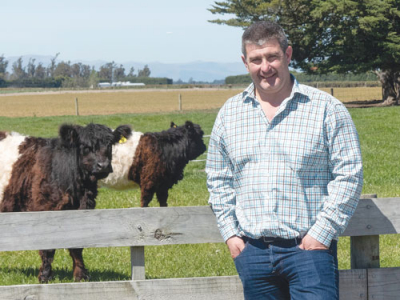
They now live with daughter Holly (14) and son George (7) on a 4ha block at Kirwee, where he runs a small herd of Belted Galloways, mostly to sell calves to lifestylers.
“But the meat’s very good on them; we usually kill one a year. The meat off them is much better than your bog-standard stuff.”
Curtis has seen huge changes since he started with Irrigation NZ 10 years ago.