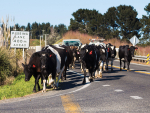
Ospri Urges Farmers To Prepare NAIT Records Before Moving Day
Moving Day (June 1) is just around the corner and farmers who are moving farms with the herd are being urged by Ospri to start preparations now.
 increase font size
 Sharon Morrell.
Moving day around the country appears to have gone relatively smoothly despite the disruption and uncertainty created by the Covid-19 pandemic.
When the level 4 lockdown came into place, there was talk about potential problems that could arise on June 1. A special working group consisting of Federated Farmers, the Dairy Women’s Network, DairyNZ, Beef+LambNZ, the NZ Veterinarian Association and MPI sat down and worked out plans and rule to deal with whatever alert level the country might be in on moving day.
About 1,200 movements involving up to 20,000 people occur on that day so good planning was essential. DairyNZ developed a website with helpful information for people moving farms.
Sharon Morrell, DairyNZ’s head of consulting officers in the upper North Island, says things appear to have gone well.
“For some farmers in Northland it wasn’t Covid that was the problem, it was a storm which blew down trees, and farmers were out helping to clear roads so that the stock trucks could get through. One farmer moving from just south of Whangarei to Kerikeri got caught out by this storm,” she says.
Morrell says before the move to alert level 2, sharemilkers and farmers were very concerned as to how they might manage moving stock and personal belongings, not to mention the stock work and paper work associated with any move. But as NZ moved down the alert levels it was clear that moving day was not going to be as bad as it could have been.
“But there were still issues such as assembling, buying, selling and moving herds that were challenging. Also there were farmers who had to buy new equipment because the nature of their new operations and they found it difficult as often they had to make purchases sight unseen,” she says.
Morrell says this reinforced the need for good planning and communication and people who did this, found that the move went well.
“By and large farmers were happy and in fact a lot happier in the event than they may have been months ago looking ahead,” she says.
Moving Day (June 1) is just around the corner and farmers who are moving farms with the herd are being urged by Ospri to start preparations now.

OPINION: The previous government spent too much during the Covid-19 pandemic, despite warnings from officials, according to a briefing released by the Treasury.
OPINION: Labour leader Chris 'Chippy' Hipkins is carrying on the world-class gaslighting of the nation that he and his cohorts started after their disastrous Covid response; now trying to undermine the Covid inquiry to protect his own backside.
OPINION: Did former PM Jacinda Ardern get fawning reviews for her book?
Good planning and communication are crucial to ensure a successful moving day.



Testing confirms H5 bird flu in a single northern giant petrel, found dead on a remote Cape Palliser beach in the Wairarapa, says Dr Mary van Andel, the Ministry for Primary Industries' (MPI) Chief Veterinary Officer.

"What's for dinner?" may sound like a simple question, but for many Kiwi parents, answering it has become a job in itself.
Fifty Eight years ago, on the 16th of August 1968, August Claas, the founder of the harvesting company and father of Helmut Claas, personally presented a Claas Senator combine harvester to Scottish farmer John Steven.
New Zealand consumers are paying more for beef mince than ever before, with the average retail price now sitting above $24 per kilogram, according to Rabobank.
State farmer Pamu has delivered its strongest operating result on record.
Four years since it was first detected in New Zealand, researchers and growers now know much more about management of maize pest fall armyworm (FAW).