
Farmers Warned Over Track Dangers After Wairarapa Floods
The terrible floods that hit the Wairarapa may have subsided, but the danger to farmers still exists, according to local Federated Farmers president Rob Hickson.
 increase font size
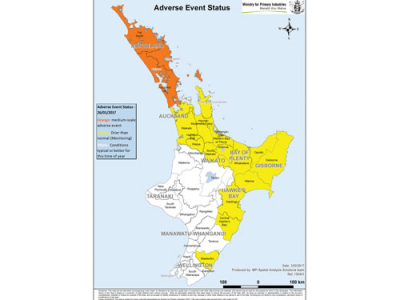 MPI is monitoring the region coloured in yellow.
Minister for Primary Industries Nathan Guy says several regions -- in addition to Northland – are under close drought watch.
Guy earlier this month declared Northland a medium scale drought area.
Also under watch are Gisborne, Hawkes Bay, Bay of Plenty, North Waikato, Wairarapa and North Canterbury.
Hawkes Bay had a regular climate briefing recently, Guy told Dairy News. Comments he heard back were “yes it was a generally dry summer but they are generally coping”.
“The group agreed the region is not near the threshold to deem it a drought as they are coping and have options available to them,” he says.
The Gisborne group is meeting this week.
“We are keeping a close watching eye on those as areas of some concern and we are keeping a close eye on parts of Wairarapa, Bay of Plenty and obviously with North Canterbury recovering they are dealing with the aftermath of the earthquake as well, so we are keeping in touch with that community.
“Northern Waikato is also of concern; parts of that are very dry.”
Northland is very dry, he says.
In 2013 the west coast of Northland was affected. This one is more prolific on the East Coast, although it is drying out in the west also now. Soil moisture deficits are about 110ml across Northland, “so that is a real concern”.
The Rural Support Trust, councils, Fonterra and Beef + Lamb NZ worked with NIWA and MPI to look at the science and the forecasting.
“As a group they collectively decided to seek some government support. MPI appraises that, puts a recommendation to me and that met the medium scale adverse drought event criteria,” he says.
With that declaration the focus will be on the coordination role by the Rural Support Trust, rural assistance payments for farmers in hardship and taxation flexibility through IRD.
“Some of the banks have come on board with a package deal to support farmers through,” he says.
“The Rural Support Trust will be watching closely the mental wellness aspect; we have put more money into that -- $1.1m in the last couple of years -- to make sure we are working constructively with the Ministry of Health, Rural Support Trusts and the Rural Health Alliance.
“There is a huge amount of work happening and farmers should realise they should pick up the phone and talk to their neighbours. Call 0800 RURAL HEALTH.
The terrible floods that hit the Wairarapa may have subsided, but the danger to farmers still exists, according to local Federated Farmers president Rob Hickson.

Testing confirms H5 bird flu in a single northern giant petrel, found dead on a remote Cape Palliser beach in the Wairarapa, says Dr Mary van Andel, the Ministry for Primary Industries' (MPI) Chief Veterinary Officer.
The apple sector is working with the Government to unlock access to two key markets that could bring millions in revenue for apple growers.
A Palmerston North shearer has been sentenced to six months' community detention and 12 months' supervision after being found to have physically abused three lambs while shearing them.
OPINION: A simpler, clearer, more effective Recognised Seasonal Employer (RSE) scheme.


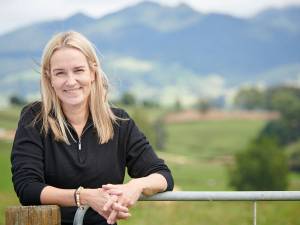
Minister of Conservation Hon Tama Potaka has appointed Susan O'Regan as Chair of the Queen Elizabeth II National Trust (QEII) for a three-year term.
Red meat farmers are welcoming Labour’s plan to review the Emissions Trading Scheme and not to campaign on pricing agricultural emissions.
Where any worker in the kiwifruit industry is mistreated, we expect the authorities to take action.
Mid Canterbury Federated Farmers arable chair, Bevan Lill, said Beef + Lamb NZ data indicated that for the last six years, the average arable return on investment was about 0.8% while inflation ran about 4% - so the average arable farm was going backwards at about 3% a year.
Seed and grain companies share the concerns of arable farmers about the viability of their sector, says Seed and Grain New Zealand chief executive Dr Sarah Clark.
The New Zealand Institute of Forestry (NZIF) says unnecessary changes to New Zealand’s Emissions Trading Scheme (NZ ETS) will seriously erode investor confidence and result in significant reductions in forest planting rates.