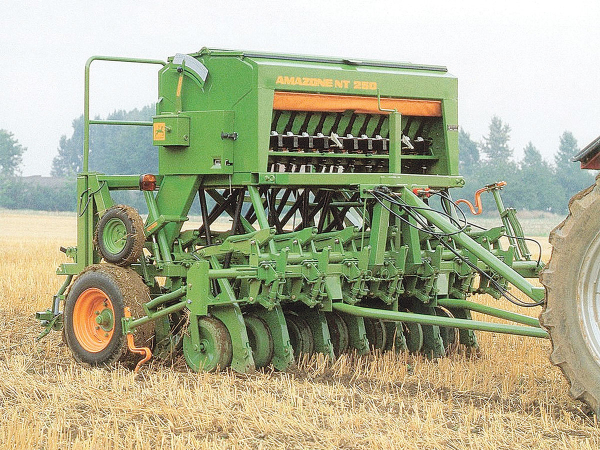
This year marks the 75th anniversary of the first Amazone seed drill – the 2m wide horse-drawn D1 launched in 1949.
Over the ensuing years, milestones have included the launch of the first seed drill combination, the RE reciprocating harrow carrying the D4 drill, in 1967. Indeed, this concept was so successful the company continues to produce thousands of drills each year that are mounted to PTO-driven KE rotary harrows and KG cultivators, or the non-powered CombiDisc.
In 1970 the company opened the Hude production facility in Oldenburg, Germany as a dedicated factory for drill and harrow production, employing experienced metalworkers who had been laid off in the collapse of the ship building industry in Northern Germany. The Hude facility continues to produce drill and harrow components, although assembly has moved to the nearby to the 18-line facility at Altmoorhausen.
Further highlights from the 1970s include the first commercially produced drill to offer a tramline system, the D7, while in the same era the EV Garant opened the door to 9m solo seeding and a 3m transport width, alongside the arrival of the NoTill drill as direct drilling became increasingly popular.
Eventually, the NT was replaced by the Primera which retained the same chisel opener principle but incorporated hydraulic folding and pneumatic seed conveyance.
Introduced in the 1990s, Airstar pneumatic seeders used a centralised metering system alongside a distribution head, feeding individual coulters via an air flow from the on-board fan. This offered the ability to completely empty the hopper, making it ideal for OSR and other small seeds where keeping a box drill covered over the full seeding width often resulted in large residues.
The introduction of pneumatic distribution systems also led to wider trailed drill working widths, such as on the Airstar Xact, and as farms continued to increase in area and min-till systems became popular, the larger tank capacity of the trailed Cirrus cultivator drill helped increase daily outputs.
The 250,000th seed drill left the factory in November 2019.
Read More: