Efficient Irrigation Improves Pasture Productivity
Increased competition for water means the whole community is looking at how irrigators use water.
 increase font size
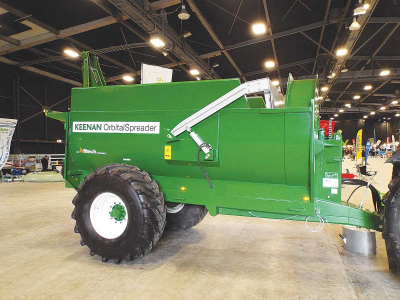 The Keenan Orbital spreader.
With travelling irrigators being the preferred choice for dealing with dairy farm effluent in New Zealand, the sight of effluent tankers or manure spreaders is a relatively rare one.
However, the problem of repeated applications to the same area is, in many cases, causing problems with high levels of potassium. Additionally, the move by some forward-thinking farmers to feedpads is resulting in the need to deal with some drier manures.
The Irish company Keenan, known for its high-capacity mixer/feeders, also makes an interesting dual-purpose machine -- the Keenan Orbital spreader, centred on a semi-cylindrical tank.
A rear mounted pushing door delivers the material to a large flywheel mounted at the front of the machine. That flywheel, a solid 1.8m diameter disc, carries six paddles and rotates at 170 rpm.
In operation, the material hitting the flywheel and the paddles is shredded then passes out for spreading through a side opening. It will spread material -- depending on its makeup -- up to 20m.
During loading and transportation, a hydraulically actuated slurry door seperates the chamber and flywheel, allowing the machine to handle both liquid and drier manures and ensuring low start-up torque.
The machine has only four key moving parts and is solidly built, so Keenan claims excellent reliability and low maintenance costs. The set-up also benefits from one main drive chain and all bearings being located outside of the main body of the spreader.
A variable rate control system for the rear door/pusher arm allows precise adjustment of material arriving at the rotor, to achieve typical spreading times of 1.5 to 5 minutes per load.
Additionally, as the load moves forward, weight is transferred to the tractor’s rear axle, for positive traction in poor ground conditions.
The Orbital has a tare weight of 5.5 tonnes and a minimum power requirement of 120hp.
Increased competition for water means the whole community is looking at how irrigators use water.

Ireland and NZ have concluded a deal to extend a joint research programme on climate change.
Ireland's Minister of state for Agriculture says it’s hard to explain to Irish farmers the size and scale of NZ farms.
Moves are afoot to get a team of Australians over here to help repair North Canterbury's irrigation machinery, ravaged by the big windstorm of late October.
Horticulture New Zealand (HortNZ) says access to reliable irrigation water is essential for a thriving horticultural sector.


Esther Guy-Meakin has been announced as the new chief executive of the New Zealand Meat Board (NZMB).

According to a progress report on the Aotearoa Horticulture Action Plan (AHAP), New Zealand's horticulture sector is making real progress on the big issues facing growers.
A team effort that is paying dividends for the wider New Zealand economy.
A strong sense of community involvement is what propelled the Federated Farmers' North Canterbury president Bex Green to the honoured title of the Feds' Advocate of the Year 2026.
The country's second largest milk processor is warning against 'complacency' during a review of competition regulations in the dairy sector.
Oamaru-based livestock handling specialist Te Pari has bought Combi Clamp, the New Zealand manufacturer of Combi Clamp manual sheep handlers.