Boosting Crop Production by Spreading Effluent
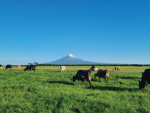
Tararua district farmer Jamie Harris milks around 400 cows using a split calving system on his farm, Crossdale Dairies.
 increase font size
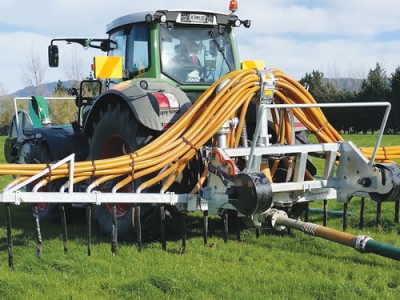 The dribble bar helps reduce N losses and reduces odour.
With the increase of standoff pads and wintering barns, the amount of slurry being stored for distribution is soaring.
Effluent traditionally spread on paddocks around cowsheds now needs spreading further afield as storage ponds increase in size. Until recently tankers have filled that role, but large volumes have pushed up the time and cost of doing this.
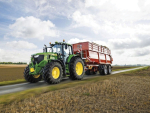
Webbline Agriculture now distributes the Slurry Quip umbilical system developed by Irishman Richard Fitzpatrick, involved there in slurry for 15 years.
Says Webbline sales manager Glen Malcolm, “We could see Slurryquip leading in effluent distribution. In the last 18 months we’ve sold 14 Slurryquip units, with several large contractors achieving outstanding results and performance.”
“Feedback from clients was on the ability move 200-300m3/hour of slurry, using a Bauer pump, operating at 6.15 bar pressure, which easily outperforms a tanker.”
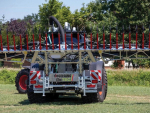
Slurry Quip offers an optional 7.5 or 9.5m dribble bar which helps reduce losses of N from 80% to 20% versus a standard splash plate system. This helps reduce odour because less ammonia is lost to atmosphere, it keeps the tractor a lot cleaner and minimises pasture contamination and re-grazing cycles.
Riversdale, Southland, contractor Waimea Contracting bought a system last spring and now can pump up to 2500m using a combination of 6in. supply hose and 5in. delivery hose.
Manager Jason Hawker comments, “Having the ability to pump over a long distance, it allows our clients to get their effluent to areas on farms that were previously uneconomical to reach with a tanker”.
“At 2500m pumping distance over flat terrain, with thick slurry, we still average 120-140m3/hour discharge rate. On the shorter jobs, say, 1000m distance we see 200-300m3/hour depending on consistency of the effluent.”
He says clients prefer the system to tankers as they see less damage to gateways and races, which occurs with repetitive movements in the same areas.
Tel. 0800 932 254
Tararua district farmer Jamie Harris milks around 400 cows using a split calving system on his farm, Crossdale Dairies.
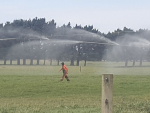
Water management is an integral component of sustainable farming practices, according to Watermetrics.
Two farmers and two farming companies were recently convicted and fined a total of $108,000 for environmental offending.
A Taupiri farming company has been convicted and fined $52,500 in the Hamilton District Court for the unlawful discharge of dairy effluent into the environment.
Founded in Germany as recently as 1977, today, the Fliegl Group employs more than 1100 workers, offering an expansive range of transport solutions, from their base in Bavaria.



Entries opened on Monday, 5 October 2026 for the 2027 New Zealand Dairy Industry Awards (NZDIA), which organisers describe as the nation's biggest celebration of excellence in the dairy sector.
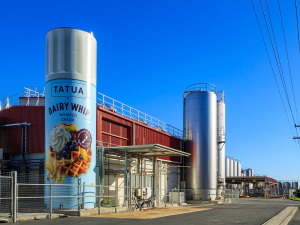
Waikato milk processor Tatua has again declared a record milk payout to farmer shareholders, leaving other processors in the dust.
A Labour-led Government won’t be bringing back the controversial freshwater rules of 2020.
National’s much-touted free trade deal with India featured in the Rural Issues Debate at Mystery Creek, Hamilton on Wednesday night.
New Zealand's 2026-27 freshwater fishing season has opened, with anglers encouraged to head to rivers and lakes over the coming days as conditions look favourable across much of the country.
Central Otago District Council (CODC) has voted against a plan to spread treated sewage sludge from Cromwell and Alexandra on farmland near Lauder, a decision Federated Farmers says reflects strong opposition from rural residents.