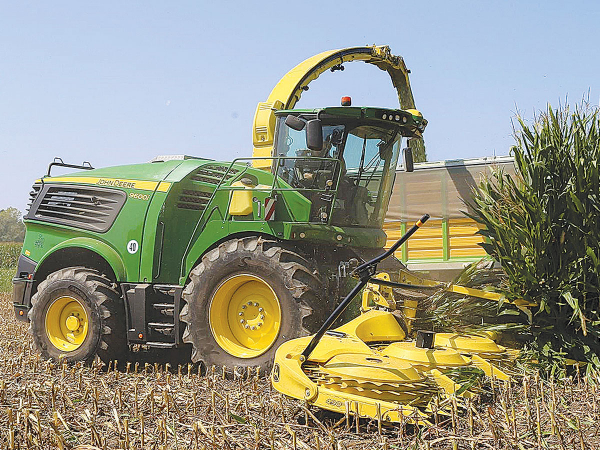
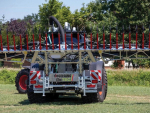
John Deere has signalled the latest additions to its self-propelled forage range with the 9500i and 9600i models.
Producing 700 and 750hp respectively, both are fitted with the new in-house, 18 litre in-line 6-cylinder engine, said to fill a gap in the range, with 10% lower fuel costs per tonne harvested, compared with current V12 Liebherr equipped models.
The engines feature Harvest-Motion Plus which delivers more torque as engine revs reduce, while pushing peak power outputs to 766 and 787hp respectively as engines drop to 1,350rpm.
Besides replacing the previous V12 engine, the two new foragers are fitted with a wider 850mm chopping cylinder, a reinforced drive train, a strengthened mainframe and a 20cm longer discharge spout. The configuration is said to offer users a slightly smaller machine, but with the power density of the larger V12 equipped models.
Kernel Processers take the form of the current standard saw-tooth design or the spiral grooved X-Cut options, each available with the Dura Line HD coating for durability and an extended service life.
Both machines are available with the John Deere Intelligent Solutions Group (ISG) precision farming systems, that include HarvestLab 300NIR for yield, moisture and constituent measurement, while also allowing AutoLoc, automated length of chop adjustment based on Dry Matter content. Other options include AutoTrac automated steering, Machine Sync to control the position and speed of trailers and AutoFill for precise trailer filling to maximise loads and reduce driver strain.
Expect machines to start hitting paddocks in 2022.