Utilisation of available grass, a key to New Zealand’s dairying success, is known to result in lower costs of production.
In Britain and Europe, where wetter seasons restrict utilisation to about 60%, many dairy farmers are switching to zero-grazing, giving utilisation of fresh grass up to 95%; and followers cite other advantages such as reduced pugging and compaction, lower fertiliser usage and the ability to feed more cows off fewer hectares.
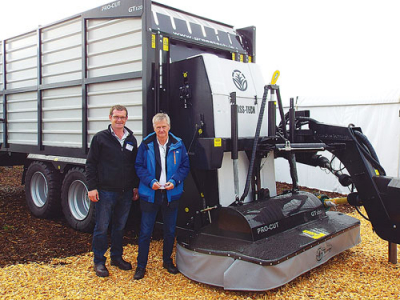
At the Fieldays, Irish manufacturer Grass Technology Ltd showed its Grazier GT 120S alongside its NZ distributor Toplink Machinery.
The six-year-old business has so far made about 1000 machines, with 500 operating in Ireland.
The GT120S can hold 25cu.m, suitable for feeding 120 cows over a 12-hour period.
Brian McArdle, for Grass Technology, says “cows will typically eat their fill in about one hour then ruminate, where the process will normally take five hours out in the paddock”.
Weighing about 9.5 tonnes fully laden, the outfit is said to require a tractor of about 120hp depending on terrain.
Up front, a Kuhn/PZ-sourced, twin drum mower offers a 2.4m cutting width and is favoured for its clean cut and minimal sward damage; it is offset to the right with a hydraulic drawbar and suspended ahead of the main body on 60mm pivots that operate with a spring suspension system to promote good ground following and a minimum cutting height of 35mm.
Cut grass is channelled to a crop conveyor that rotates at a slow 70rpm to lift grass into the body, in such a way as to avoid damaging the grass and maintain maximum nutritional value.
The trailer body, in a robust frame, has double-lined construction that gives long service life, and has a chain-and-slat system in the floor to transport the cut grass rearwards as the body fills. Filling to capacity is controlled by the variable rate floor speed, with load sensors at the rear to prevent overload.
The unit on display has the optional rear cross conveyor attachment that is fed by a three-beater discharge system; this enables feeding out to either side of the machine.
The running gear has segmented double-bogie axles fitted with greaseable bronze bushes for a long life, and the option of a wetland set-up allows offsetting of the wheels on the GT 120.
Standard equipment includes flotation tyres, hydraulic brakes and twin rear-view cameras. It is powered by the tractor PTO and two double-acting rear remotes.
Controls will be updated for the 2019 season.