Boosting Crop Production by Spreading Effluent
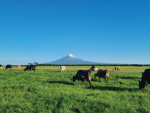
Tararua district farmer Jamie Harris milks around 400 cows using a split calving system on his farm, Crossdale Dairies.
 increase font size
 Bala Tikkisetty.
Dairy effluent is a great source of nutrients for growing pasture.
But if not managed properly effluent can also be a significant source of contaminants which harm our waterways.
Understanding how soil properties affect nutrient loss is a key to maximising the benefits of effluent on farm and minimising its impacts on waterways.
Soil texture and structure determine the amount of water that can enter and be retained within a particular soil, and the rate of transmission of excess water through that soil. So, effluent irrigation systems should be matched to soil properties to minimise runoff and leaching.
The rate at which effluent can be applied to land for maximum production benefit is determined by the soil’s properties including structure, porosity and infiltration rate.
The nature of the effluent and cattle treading on soils can affect the infiltration rate. Treading damage, which occurs most when the soils are wet, significantly reduces the infiltration rate. For some soils this can result in accumulation of effluent below slopes and in hollows. It can then enter surface waterways.
Movement of water through soil pores is generally described as hydraulic conductivity; when this is low, irrigation of effluent will result in ponding and run-off once the total water capacity of the soil is exceeded or if application rate exceeds infiltration rate.
Low rates of hydraulic conductivity are found in soils that are poorly drained, and ponding and runoff often occur with high rainfall. Many of these soils are artificially drained to reduce the incidence of ponding and water-logging, and this carries a risk that effluent can bypass the soil and be directed rapidly into waterways
Leaching occurs as excess water moves through the soil. So, soils with lower water holding capacity are more susceptible to leaching, while soils with high water holding capacity (deep silt loams) can store significant quantities of effluent.
Soils with low available water holding capacities are the shallow to moderately deep soils, and sandy or stony soils.
Effluent irrigation on these soils is likely to result in leaching unless it is applied at low rates and in small doses. The irrigation system on these soils must be capable of low rates of application to gain the maximum nutrient benefit.
Drainage and the level of biological activity of the soil at the application site are important. Aim to apply effluent at a rate that keeps it in the root zone so that the nutrients can be utilised by pasture.
Permeable soils with a deep water table and no drainage limits are best for putting effluent on. However, on stony soils the risk of effluent draining directly to ground water would be an issue to consider. In such situations, application depths and rates should be adjusted to account for this risk.
• Bala Tikkisetty is a sustainable agriculture advisor at Waikato Regional Council. Contacts: This email address is being protected from spambots. You need JavaScript enabled to view it. or 0800 800 401.
Tararua district farmer Jamie Harris milks around 400 cows using a split calving system on his farm, Crossdale Dairies.
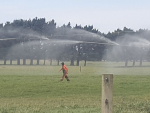
Water management is an integral component of sustainable farming practices, according to Watermetrics.
Two farmers and two farming companies were recently convicted and fined a total of $108,000 for environmental offending.
A Taupiri farming company has been convicted and fined $52,500 in the Hamilton District Court for the unlawful discharge of dairy effluent into the environment.
Founded in Germany as recently as 1977, today, the Fliegl Group employs more than 1100 workers, offering an expansive range of transport solutions, from their base in Bavaria.



Entries opened on Monday, 5 October 2026 for the 2027 New Zealand Dairy Industry Awards (NZDIA), which organisers describe as the nation's biggest celebration of excellence in the dairy sector.
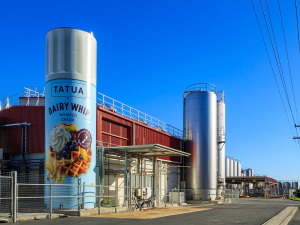
Waikato milk processor Tatua has again declared a record milk payout to farmer shareholders, leaving other processors in the dust.
A Labour-led Government won’t be bringing back the controversial freshwater rules of 2020.
National’s much-touted free trade deal with India featured in the Rural Issues Debate at Mystery Creek, Hamilton on Wednesday night.
New Zealand's 2026-27 freshwater fishing season has opened, with anglers encouraged to head to rivers and lakes over the coming days as conditions look favourable across much of the country.
Central Otago District Council (CODC) has voted against a plan to spread treated sewage sludge from Cromwell and Alexandra on farmland near Lauder, a decision Federated Farmers says reflects strong opposition from rural residents.