Dean Astill reflects as Young Horticulturist of the Year comp turns 20
Acclaimed fruit grower Dean Astill never imagined he would have achieved so much in the years since being named the first Young Horticulturist of the Year, 20 years ago.
 increase font size
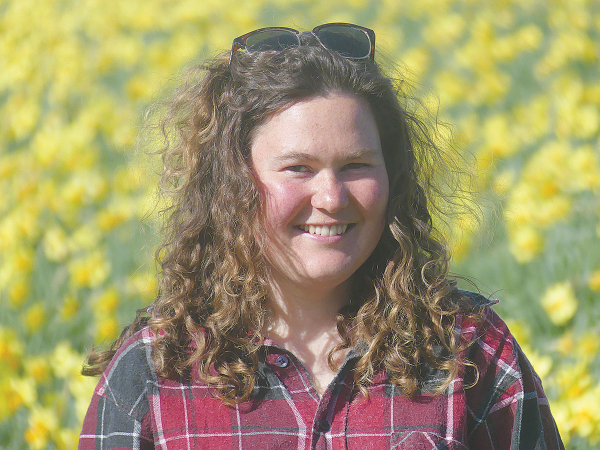 Canterbury flower grower Courtney Chamberlain is a finalist in the national Young Horticulturist of the Year competition.
"My passion is flower growing,” explains Courtney Chamberlain.
“I love being outdoors. I love what we do and I love working with family.”
The 28-year-old, who works as the assistant manager on the six-generation Chamberlain family flower farm, Hadstock, is a finalist in the national Young Horticulturist of the Year competition, to be decided in November.
Hort News last visited Hadstock, one of the country’s biggest flower growers, in 2016. Then, Courtney Chamberlain was halfway through law and commerce degrees at Canterbury University. Now she has completed both degrees, as well as her professional law qualification.
One might think the world is her oyster. But she chooses to stay on the farm.
Chamberlain explains that the degrees give her options “but this is where I want to be.”
“I think we’re very lucky to be here. We’re in a beautiful spot and I think that’s where my real passion is.”
Hadstock, at Springston, near Christchurch, is about 150ha with about a sixth of that in flowers at any one time. Blooms are picked for the flower markets between June and October. Bulbs are lifted in summer for sale to home gardeners.
The farm has been in the Chamberlain family since 1878 and has been progressively converted to flower growing from the 1930s.
The whole family is involved, including Courtney’s parents John and Cynthia, sisters Jessica and Hannah – and now, Courtney’s and Jessica’s partners.
Chamberlain says it has been a tough year, with “strange weather” – few frosts but a huge amount of rain.
A paddock of daffodils in full bloom makes for a glorious display but it is too late to pick them for commercial sale.
Chamberlain points out a newly planted patch in what was to have been its first year of production. It was planted in bulbs that had been cool stored to force them into flowering early. But then the rains came.
“Where the ground’s been recently worked up when you’re planting the bulbs, it can get very muddy out here. You can’t pick them when it’s super wet like that,” she told Hort News. “So unfortunately, this paddock has been missed this year but in saying that, it is better for the health of the plants. Hopefully, next year will be better.”
Fulfilling daffodil orders for the Cancer Society’s annual Daffodil Day appeal in late August is the farm’s most hectic time of year, Chamberlain says.
“We’ve still got our double varieties to come in yet, and our jonquil varieties such as white cheer and yellow cheer,” she adds. “Into the season we get our bluebells and then we have tulips as well. And we grow other varieties throughout the year like oriental lilies, peony roses, gladioli, the mixture of calla lilies, a range of things.”
Environmentally Friendly
With the family farm bordering the Selwyn River, there is an increasing environmental focus.
However, Chamberlain says flower growing is inherently environmentally friendly, especially in the way they rotate the paddocks.
“We’ve been doing this my whole life,” she says. “The paddocks will be down for a few years. We’ll lift the bulbs out, we’ll put them into grass again, and then they won’t go back into bulbs for another few years.”
She says there is more attention drawn to environmental issue nowadays.
“But I feel that as a farmer you always care about the land and you want to do what’s good for the environment,” she told Hort News.
Chamberlain says the biggest change over the years is in the gear and machinery.
Not only are modern tractors more luxurious than “the old tractors that my granddad drove” the farm now has machines that lift swaths of bulbs and wash the soil off them when it’s time to lift and separate them and rotate the paddock.
“Even in my lifetime it’s changed a lot. When you try to do all that by hand, it’s a huge amount of workers.”
Picking flowers for sale, however, is still done by hand.
Hiring, training and supervising staff is one of Chamberlain’s roles on farm. Hadstock employs up to 30 pickers, some of whom have been with them for 15 years or more. This year they have taken on a number of Lincoln University students as well.
Acclaimed fruit grower Dean Astill never imagined he would have achieved so much in the years since being named the first Young Horticulturist of the Year, 20 years ago.
Nina Downer, New Zealand Young Viticulturist of the Year 2024, will compete against the best in the field on 5-6 November, including national winners from the arborist, florist, plant producer, amenity, and grower sectors.
Soljans Estate Vineyard Manager Tai Nelson will compete for the title of 2024 Young Horticulturist of the Year in Auckland at the end of October.
Meryn Whitehead has taken out the coveted title of New Zealand Young Horticulturist of the Year for 2023.
Hawke's Bay apple grower Regan Judd has won the title of Young Horticulturist of the Year.

Forestry Minister Todd McClay has today congratulated the winners of the 2026 Growing Native Forests Champions Awards at Fieldays.

The Government has announced $60,000 to provide one-off grants of $1,000 to each of the 60 New Zealand Young Farmers (NZYF) clubs across the country.
New Zealand’s rural sector has once again demonstrated its generosity, with the second Rural Industry Leaders Dinner, Debate and Auction raising an impressive $400,000 for the Rural Support Trust.
There has been another twist to the Federated Farmers annual election fiasco.
Analysis of decades of research has revealed the implementation of good farming practices plays a critical role in reducing nutrient losses to improve freshwater outcomes.
Yesterday the Government used the opening of Fieldays to announce a major investment, as part of its Land Use Flexibility package, to support a more productive and sustainable future across six sectors including dairy.