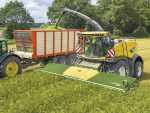
Krone XDisc 710 Now Fits John Deere, New Holland Foragers
Krone's XDisc 710 direct-cut header can now be used by John Deere and New Holland forage harvesters, as well as the Krone Big X it was originally designed for.
 increase font size
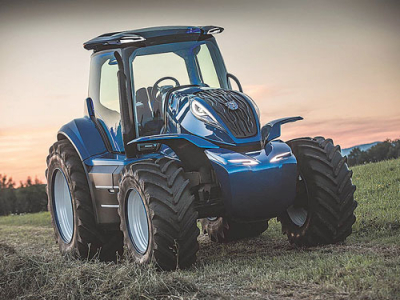 New Holland’s hydrogen tractor is likely to be on the market soon.
Hybrid or electric vehicle (EV) makers had better mind their backs: the hydrogen fuel cell could still be in contention.
From an efficiency point these are at least twice as efficient as petrol or diesel powertrains, so only need half the fuel. But it seems that the biggest challenge holding the technology back is issues of safe storage and transport.
The technology might now have moved a step closer to commercial reality: Australia’s CSIRO has developed a membrane technology process that enables safe and efficient production of ultra-pure hydrogen by extracting it from ammonia.
“Hydrogen fuel cells can be fitted to a wide range of vehicles -- cars, tractors, ships -- but concerns remain about safety during storage and transport,” says CSIRO principal research scientist Dr Michael Dolan.
“Our technology allows extraction from ammonia that increased safety and had benefits in handling and storage”.
Dolan says to move a lot of hydrogen it must be in liquid form -- much more dense than gaseous fuels. In the case of hydrogen, this is difficult to achieve without resorting to very low temperatures; but ammonia (nitrogen and hydrogen) forms a liquid at mild temperatures and behaves much like LPG.
In practical terms, ammonia carries a lot of hydrogen; the challenge is to pull that hydrogen back out, and it’s now achievable with CSIRO’s new membrane technology. From a safety aspect, ammonia suits transport and storage because it burns slowly and is hard to ignite.
Before long, says Dolan, fuel cells will be used in all forms of transport including tractors. For example, New Holland’s hydrogen tractor is reckoned likely to be on the market within three years.
He says CSIRO is also researching solar energy, bio-mass and other renewable sources and is making ammonia production more efficient -- the latter having implications for fertiliser production.
And there is new interest in straight ammonia as a substitute fuel for diesel in tractors, a process trialled in the US with reasonable results.
Krone's XDisc 710 direct-cut header can now be used by John Deere and New Holland forage harvesters, as well as the Krone Big X it was originally designed for.
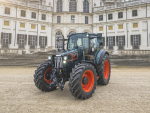
Creating a great deal of enthusiasm at Agritechnica, the T5.120 ‘Il Trattore’ styling concept tractor was celebrating the legacy of research and development, engineering, and design expertise, with the concept bearing a striking green and red colouring and styling inspired by the original first Fiat tractor, the Fiat 702 and the ‘Made in Italy’ logo.
First unveiled in 2023, New Holland has announced the addition of the T7.270 Methane Power CNG (Compressed Natural Gas) tractor to the recently expanded T7 Range.
A group of eight Giltrap Agrizone customers travelled to Europe in July with managing director Andrew Giltrap, taking the opportunity to visit St Valentin, Austria, to see New Holland tractors being built.
Showcased with a T7.245 at the recent National Fieldays, New Holland has expanded its T7 tractor range offering in New Zealand with the launch of a new Tier 3 long-wheelbase configuration, aimed at users looking for a reliable, no-fuss workhorse.


South of the central Hawke’s Bay town of Waipukurau is Taniwha Station – a highly successful 550ha bull beef farming operation.
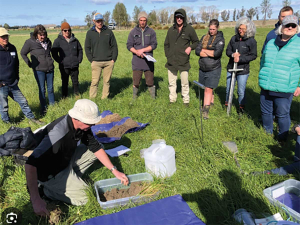
Beef + Lamb NZ funded research has shown that some simple changes to pasture management could help farmers make better use of rainfall and build resilience before dry conditions hit.
OPINION: There could hardly be a more appropriate theme for a conference than the one chosen by the red meat sector - Navigating Volatility.
When Northland leather worker Vernon Suckling started making horse saddles 50 years ago, quad bikes and side-by-side vehicles were unheard of.
Alliance Group has confirmed that eligible farmer-shareholders who supply and continue to back the business will receive up to $20 million later this year, following the strategic investment partnership with Dawn Meats.
With a general election under five weeks away, Rural News is asking major political parties about their policies and positions on key issues facing the primary sector. We will run their responses to each question over the next four weeks. The ACT Party and the Greens didn't respond in time.