Lanaco and Blueair Launch World-First NZ Wool Air Filter
New Zealand wool is reaching new heights as air filtration companies move away from synthetic products to biodegradable alternatives.
 increase font size
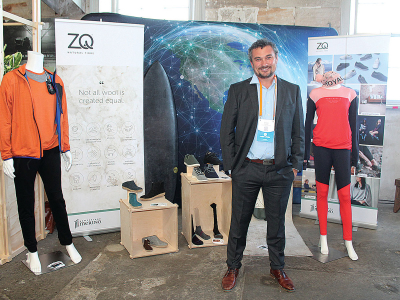 NZ Merino’s Dave Maslen.
Disruption is happening whether we like it or not, says Dave Maslen, NZ Merino general manager for markets and sustainability.
“We need to embrace that and turn it into an opportunity and remain distinct.
“We are a very small part of a very big world and our need for consumer intimacy has never been greater than today.”
Maslen spoke to Rural News at the Rabobank Farm2Fork seminar in Sydney on March 28 where a NZ Merino display of Icebreaker, All Birds and ZQ was drawing the crowds.
Maslen said it has been hugely useful to attend the event.
“Every time you get a gathering of rural professionals together in the same room ideas tend to bounce. As an organisation we are constantly on the lookout for what is coming over the horizon at us that is going to impact on the brands we work with and is going to impact on the growers that supply us.
“This is a great way for us to put a way-point in the ground in terms of what is coming over the horizon, be it environmentally, animal welfare, social responsibility and those sorts of things. It has been fascinating.”
The main message for him was the rate of change and the rate of disruption occurring in the primary sector “whether we like it or not”.
“And the challenge to industry to build resistance to that level of disruption. So how are we going to embrace it and turn it into an opportunity? That has been to me the key theme that has come out of it.
“That is something [in which] we are pretty well versed in New Zealand in our industries and it will continue in the long term as well -- the constant need to reinvent, be aware of what consumers are asking for, customise our supply bases to what those consumers need constantly.”
NZ Merino is already doing that.
“That is fundamental to our business model; the consumers that are using the wool out there in the market, the people who are buying the All Birds or Icebreaker, trying to understand what it is they need today and tomorrow and signalling that clearly to our growers so that they are forewarned and future-proofed.”
Earlier Maslen was in a panel discussion on why the ag sector needs to transform. He said at that discussion that the disconnect between consumer and producer is widening.
“You get disrupted by not being aware of what is going on around you. While exceptional R&D is occurring, whether or not it is actually the R&D required to drive the industry forward in the eyes of the consumers is another big question.
Business and educational institutes needed to develop the talent to take our economies to the market and make the best of that new technology.
New Zealand wool is reaching new heights as air filtration companies move away from synthetic products to biodegradable alternatives.
Will a stronger, more coordinated voice help rebuild confidence and improve returns in the wool sector?
OPINION: Confidence in the wool sector is rebounding as prices hit levels not seen in more than 15 years.
The recently signed free trade agreement with India is an invitation to strengthen relationships between the New Zealand and Indian strong wool industries, says Wool Impact chief executive Andy Caughey.
Strong competition and tightening supply have seen wool reach its highest prices paid at auction since 2011.


As the India-New Zealand free trade agreement enters into force, New Zealand’s apple industry has reaffirmed its commitment to the long-term development of India’s apple sector.
Fonterra shareholders can begin voting on Tuesday 20 October in the 2026 Board of Directors’ election, a Co-operative Council election in one Ward, and seven Annual Meeting resolutions.
National’s pledge to introduce 19 new national standards shows the party is serious about getting Wellington out of farming, Federated Farmers says.
The National Party’s policies to make it easier to grow fresh vegetables, secure reliable water and energy and simplify farm planning are practical changes that will give growers the confidence to invest, according to Horticulture New Zealand (HortNZ).
Fonterra Co-operative Group chief financial officer Andrew Murray has resigned to take up a role outside the dairy giant.
A major move is about to get underway to improve the quality and viability of dairy beef and cattle in NZ.