NZKGI Responds to Migrant Worker Exploitation Reports
Where any worker in the kiwifruit industry is mistreated, we expect the authorities to take action.
 increase font size
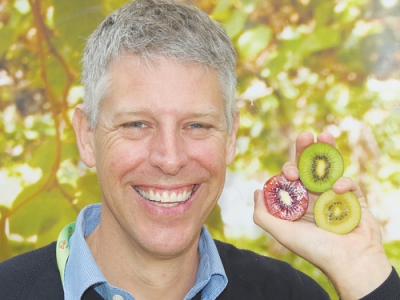 Zespri chief executive with examples of red, green and gold kiwifruit.
The kiwifruit industry is just about back to where it was before PSa, says Zespri chief executive Lain Jager.
He says this year will have seen a recovery of gold kiwifruit to 32 million trays, almost the same as in the days before PSa and triple the low of 11 million trays in 2012.
Jager told Rural News at Fieldays that the recovery is tremendous news for New Zealand kiwifruit growers, who have seen land prices recover and a huge sense of optimism in the industry.
Zespri operates at a significant competitive disadvantage costwise relative to its main southern hemisphere competitor Chile, Jager says.
“That means we can’t be the lowest cost producer, so we have to brand our product, position it at a premium level in the market and focus on quality and taste. That gives us the opportunity to have great fun with innovative marketing programmes around the world.”
On innovative marketing, Jager says Zespri is tremendously pleased with the marketing they have developed with McDonalds restaurants in Mexico.
“That’s a fantastic position for us because it’s about health and kids having fun and we are hugely excited about that.”
A Zespri strength is the close relationship between growers and the marketing arm of the company, Jager says. This is vital to building a strong brand producing a premium product and securing good prices for growers.
“The Zespri brand is now the fifth strongest brand in fruit globally. That’s remarkable because it’s only been in the market since 1998, so it’s still a new brand. But it is strongly supported by growers with promotional funds: this year 77 cents/tray for green kiwifruit and over $2 a tray for gold.
“Growers are investing in promotion and support of that brand and that means consumers can recognise our quality through the brand. It’s all part of the value proposition that says ‘here’s a premium, healthy fruit and this is what Zespri means in health and vitality’. This is giving us recognition and excitement in the markets and powering our growth.”
Jager says Zespri spends $20 million on R&D each year, half of which goes on plant breeding. It is now developing a new variety of red kiwifruit and test marketing it in Australia and Singapore.
“Red kiwifruit is very challenging commercially because it’s small. It’s a short-storing variety but we know consumers want red kiwifruit. We are working with Plant and Food Research to breed bigger, longer-storing, vibrant highly flavoured red kiwifruit.”
Where any worker in the kiwifruit industry is mistreated, we expect the authorities to take action.

Kiwifruit growers are watchful but remain optimistic as concerns around the potential effects of the El Niño weather pattern this season.
More signs of a booming kiwifruit sector.
After delivering a strong financial year, rural trader PGG Wrightson says the coming months will depend on customer confidence and weather.
New Zealand growers have always adapted to changing conditions, but one challenge is steadily gaining ground across the horticulture sector: resistance.


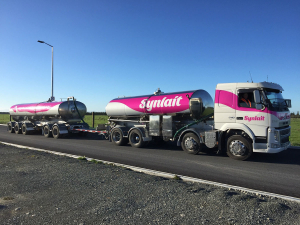
Synlait has swung to second-half profit as operations stabilise, but the dairy processor still posted a $75.4m annual loss.

LIC shareholders have elected a new North Island representative to the co-operative's Board, along with five representatives to its Shareholder Reference Group (SRG), following the company's Annual Meeting held in Invercargill.
Farmers across parts of Southland and South Otago are continuing to deal with difficult conditions after a prolonged run of wet weather, with pressure building around feed supply, stock management, pasture damage, farm infrastructure and everyday workloads.
Federated Farmers says it welcomes Labour's commitment to reviewing the Sharemilking Agreements Act, calling on other major parties to do the same.
For Canterbury dairy farmers Sian Meijer and Rick Wobben, wearable technology has become one of their most valuable on-farm tools - helping manage 1850 cows across an expansive, high-performing dairy operation while improving efficiency, mating outcomes and day-to-day decision making.
Fonterra has unveiled its annual results for the 2026 financial year, posting $27 billion in revenue and close to $20 billion returned to New Zealand farmer owners and unit holders.