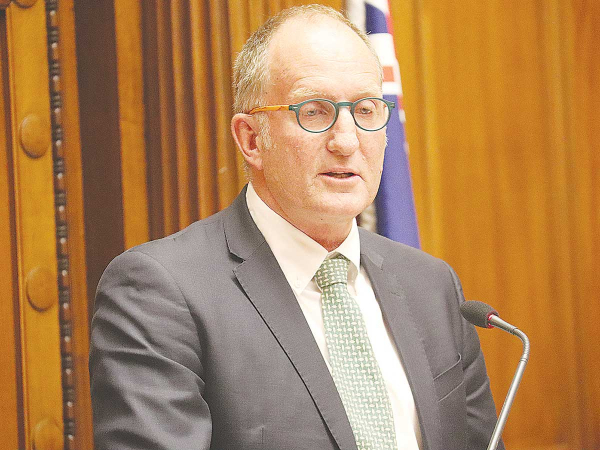
Beef+Lamb New Zealand chair Andrew Morrison says his organisation understands farmers' concerns about the He Waka Eke Noa (HWEN) recommended option.
"This is a complex issue with significant implications and it's really important that we listen and talk with all our farmers and ensure they fully understand what's proposed," he told Rural News.
"Like farmers, we would prefer there was no pricing of agricultural emissions. However, the Government has already passed a law that means emissions will be priced through the Emissions Trading Scheme (ETS) if we don't make progress on HWEN."
Morrison says the groups behind HWEN fought to have an opportunity to develop an alternative pricing mechanism to the ETS and convinced the Government in 2019 to work on an alternative.
"At that time, the Government had legislation written to bring us into the ETS in 2020," he explains;. "The ETS would be far worse for our farmers. We would lose the split gas methane target; effectively facing a net zero target for methane, and the methane price would be linked to the soaring carbon price."
Morrison says under the ETS farmers also wouldn't have access to the additional sequestration in the HWEN proposal or payments to farmers for using technologies that reduce their emission like low methane sheep. "While they (the HWEN proposals) still need work, the split gas methane targets were a win for agriculture in 2019 because around 19,000 consultation submissions had supported all gases going to net zero."
He concedes that the HWEN proposal is "not perfect". However, Morrison says with agriculture remaining outside the ETS, it will have the opportunity to refine HWEN over time as new science, technologies and mitigation tools become available.
"We are really conscious of the potential financial impact on farmers. This is a fundamental reason we have fought to stay out of the ETS," he told Rural News.
Morrison says the HWEN partners have tried to manage the financial impacts within HWEN, including through the price setting principles, which are supposed to take account of economic impacts and emissions leakage.
"We also pushed for a recommended maximum starting rate for methane of 11c per kilo to be held for the first three years and a specific levy relief provision," he adds. "For farmers that do not have sequestration or access to effective mitigation technologies, there is a specific proposal for providing levy relief on a case-by-case basis."
Morrison says sequestration is a deal-breaker.
"While we are conscious some farmers, especially in the South Island, don't have access to this, if that were to be carved off, this would fundamentally change HWEN, and we'd need to reconsider our involvement."
Morrison admits the agriculture sector didn't get everything it wanted.
"However, HWEN recognises a wider range of vegetation than the ETS. It also recognises native vegetation that is ineligible under the ETS," he claims. "Our long-term goal is to get the ETS improved to include this vegetation, but the reality is this will take years."
Morrison says if farmers are to face a price for their emissions, it's a bottom line they have to be able to get proper recognition for their sequestration from that day.
"That's why we are pushing for it to be HWEN for now."
He says outside of HWEN, BLNZ have been urging the Government to review the "unfairly high" methane reduction targets in legislation, currently a 10% reduction by 2030 and a reduction of between 24-47% by 2050.
"The target for carbon dioxide is to get to net zero (or no additional warming) by 2050. Based on the latest science, an equivalent target for methane to contribute no additional warming would be a 10% reduction by 2050," Morrison adds.
"We're also urging the Government to report on warming as well as emissions and to ensure the legislated review of these targets in 2024 uses the latest science - that means using appropriate metrics such as GWP*."
He says BLNZ is working across the agriculture sector with dairy, deer and arable on this.