US Launches Lamb Safeguard Probe, NZ Exports at Risk
As expected, the US has launched a safeguard investigation into lamb imports, a move that could impact New Zealand sheepmeat returns.
 increase font size
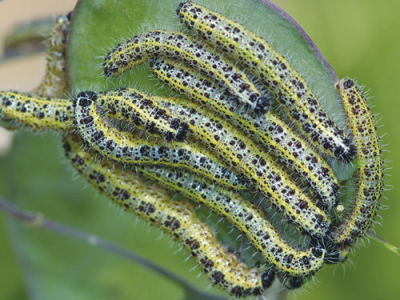 Great White Butterfly caterpillars.
Eradication of the great white butterfly – a threat to brassicas including forage crops and commercial vegetables – is a world-first achievement, says Primary Industries Minister Nathan Guy.
The eradication was officially announced on November 23, Guy claiming it as a major illustration of how a new biosecurity strategy – announced the day before – can work using community involvement.
Nelson children played a role in eradicating the great white butterfly which can devastate vegetable and dairy forage crops. The butterfly is also a big threat to native species.
Experts at the Biosecurity Forum 2016 in Auckland in late November told Rural News that the butterfly bounty scheme involving kids – initially laughed at – played an important role in eradicating the butterfly. It particularly showed how biosecurity awareness could be engendered in a younger generation.
“A $10 bounty for dead butterflies was a powerful incentive during the spring school holidays in 2013, with children netting 134 of them,” Conservation Minister Maggie Barry says.
It is the first eradication of an unwanted butterfly population in the world, Barry says. Community involvement on a wide scale was crucial.
DOC rangers did 263,000 searches on 29,000 properties in the Nelson region for the butterfly and its eggs, caterpillars and pupae.
“People also kept watch for the butterflies, reported finds and allowed repeated searches of their gardens; all in all, without the help of the people of Nelson the butterfly may well have eventually spread across the country,” Guy says.
The great white butterfly, first seen in Nelson in 2010, is a major pest of brassica crops. Caterpillars feed voraciously in groups, rapidly reducing host plants to skeletons.
The director-general of the Department of Conservation, Lou Sanson, says the great white butterfly eradication is probably their most successful such campaign. DOC first thought it would cost $20 million, but it ended up costing about $5m over four years.
One of five key strategies of Biosecurity 2025 is to have “a biosecurity team of 4.7 million -- participation on a grand scale, with every New Zealander and every NZ business becoming part of the team,” Guy says.
It aims to have by 2025 at least 75% of adult NZers understanding biosecurity.
Guy announced the Biosecurity 2025 strategy at the “Protecting to Grow New Zealand” forum in Auckland.
Aside from biosecurity awareness among 4.7 million people, other targets to be reached by 2025 include:- Having 90% of relevant businesses actively managing pest and disease risks
- A publicly accessible network that enables electronic access to organism data held by central government agencies, regional councils and Crown research institutes
- Public and private investment doubling to at least $80 million in science for biosecurity, with at least 50% of the investment focused on critical biosecurity areas
- Identifying 150,000 skilled people who can be quickly drawn on to support responses to biosecurity incursions. About 60,000 people would now be available.
As expected, the US has launched a safeguard investigation into lamb imports, a move that could impact New Zealand sheepmeat returns.

New Zealand's red meat sector says it welcomes the Government's focus on trade ahead of the general election in November.
New Zealand red meat exports are booming but a pending decision in the White House, Washington D.C., could dent sheepmeat earnings.
Politicians calling for New Zealand to withdraw from the Paris Agreement on climate risk damaging two of our gold-plated free trade deals.
Prime Minister Christopher Luxon says the red meat sector is doing an excellent job promoting our pasture-fed system around the globe.


Farmgate lamb prices are down by 8%, beef cattle by 4.5% and farm expenditure up by 4.2%.
Kiwifruit growers are watchful but remain optimistic as concerns around the potential effects of the El Niño weather pattern this season.
Almond hulls sourced from Australian orchards may have the potential to help New Zealand cows reduce emissions, boost milk yield and lower input costs.
Striking a balance between meeting the needs of industry to speed up approval time for products but on the other hand ensuring that risks are properly assessed.
Surprised, humbled and quite thrilled. That’s the reaction of James Allen, one of the founding partners and now chief executive of AgFirst, on being made a life member of the Institute of Rural Professionals.
It was billed as a chance for all the political parties to woo the rural vote, but question marks hang over just how effective this was.